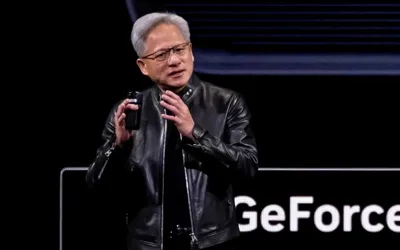
At the CES 2026 conference, Nvidia CEO Jensen Huang introduced a technological marvel that promises to completely revolutionize the world of autonomous driving Alpamayo.
This groundbreaking AI platform is designed to empower self-driving cars with the ability to think, reason, and adapt like human drivers, setting the stage for a new era of intelligent, human-like autonomous vehicles.
"Alpamayo introduces reasoning to autonomous vehicles, enabling them to navigate unpredictable environments, make critical decisions, and explain their actions in real-time just like humans," Huang proclaimed during his presentation.
In a powerful follow-up, Huang also revealed Nvidia’s partnership with Mercedes-Benz, with the tech giant's Alpamayo-powered driverless Mercedes-Benz CLA set to hit the streets soon. The vehicle will first launch in the US, followed by European and Asian markets.
This collaboration marks a pivotal moment in the autonomous driving industry, where Alpamayo could push past the current limitations of self-driving technology.
Dressed in his signature black leather jacket, Huang described the project as a monumental leap forward, giving Nvidia unparalleled insight into the building blocks of intelligent robotic systems.
Industry analysts are already calling this development a game-changer. Alpamayo represents Nvidia’s bold move from merely providing AI hardware to creating a fully integrated AI platform capable of powering entire ecosystems of autonomous systems. “Nvidia is setting itself apart, not just as a hardware leader, but as the architect of the next-generation AI platform,” said Paolo Pescatore, an analyst at PP Foresight.
The AI platform’s launch has sent shockwaves through the tech industry, with Nvidia’s stock rising after Huang’s presentation. Alpamayo was demonstrated in a video featuring a Mercedes-Benz CLA driving autonomously through San Francisco.
The car effortlessly navigated the city, with a passenger sitting hands-off behind the wheel, explaining that the vehicle “learned” directly from human drivers and reasons through every decision it makes.
Alpamayo is now available as an open-source AI model on Hugging Face, making it accessible to autonomous vehicle developers worldwide. Researchers can freely access and retrain the model, accelerating advancements in self-driving technology.
“Our vision is simple but ambitious: to make every car, every truck, fully autonomous,” Huang stated confidently, signaling Nvidia’s commitment to leading the autonomous revolution.
This bold leap by Nvidia has the potential to disrupt Tesla’s Autopilot, with Huang’s vision pushing the boundaries of autonomous driving further than ever before. Elon Musk, while acknowledging the ambition, tweeted that achieving 99% autonomy was feasible, but solving the final 1% would remain a significant challenge.
Additionally, Nvidia announced its Rubin AI chips, which are set to deliver more efficient AI computation, further reducing development costs and making the future of AI-driven technology more accessible than ever.
With a market cap over $4.5 trillion, Nvidia is not only redefining AI it’s reshaping the entire tech landscape. With Alpamayo, Nvidia has made it clear that the future of autonomous driving is no longer just a possibility it’s happening right now.