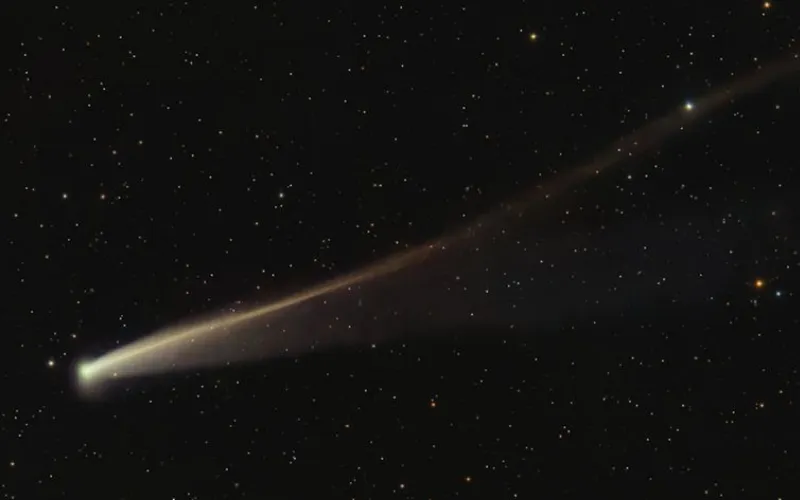
Skywatchers, prepare for a once-in-a-lifetime celestial spectacle! The newly discovered Comet C/2025 R3 (PanSTARRS) is set to streak across the night sky this April.
Dubbed the “Great Comet of 2026,” it could be the brightest comet of the year, potentially visible even with the naked eye, thrilling astronomy enthusiasts and casual skywatchers alike.
Comets are among the most breathtaking phenomena in the night sky, soaring across the darkness in fiery brilliance. Last year, several comets, including Comet C/2025 A6 (Lemmon), dazzled observers with stunning displays, such as its vibrant green hue.
The 2026 visitor, C/2025 R3 (PanSTARRS), was discovered in September 2025 by the Panoramic Survey Telescope and Rapid Response System (PanSTARRS). This comet is relatively new to science and likely takes over 1,000 years to complete an orbit around the Sun, making this a rare and exciting event for stargazers worldwide.
The comet is expected to reach its closest point to the Sun on April 20, followed a few days later by its nearest approach to Earth on April 27, at a distance of approximately 44 million miles still much farther than the Moon, which orbits at about 239,000 miles.
Astronomers are uncertain exactly how bright the comet will appear, but it could become the brightest comet of 2026. Depending on conditions, it may be visible to the naked eye, or observers might need binoculars or a small telescope. Scientists will provide more precise visibility updates as the comet approaches.
For the best chance to spot it, stargazers should look to the skies on April 17, the date of the New Moon, which provides the darkest skies for optimal viewing. As the comet draws closer to the Sun, it may temporarily become harder to see, but visibility could improve again in late April.
This April, astronomy enthusiasts and casual skywatchers alike will have the rare opportunity to witness a celestial traveler unseen for over a millennium, streaking across our skies in a dazzling display of cosmic wonder.