In a rare twist aboard the International Space Station, four astronauts are heading back to Earth ahead of schedule after a medical concern forced NASA to shorten their mission a first in the station’s history.
Orbiting 400 kilometers above the planet, these spacefarers had been living and working in microgravity for almost five months, pushing the boundaries of human endurance, when an unexpected health issue turned their journey into a race against time.
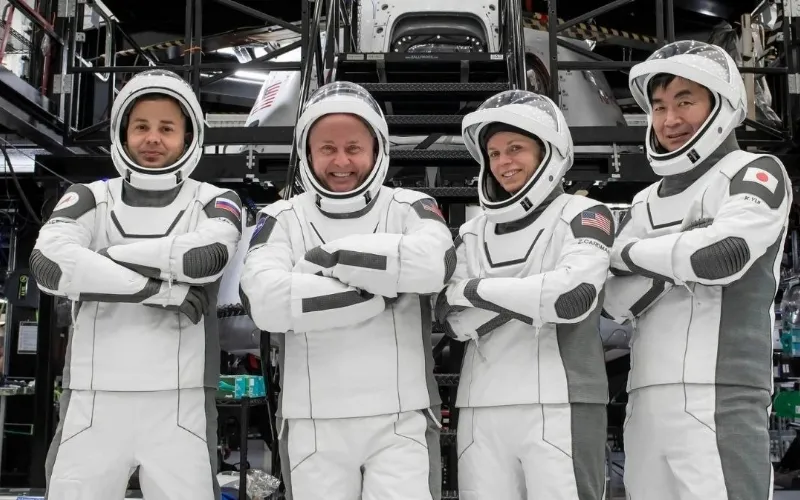
American astronauts Mike Fincke and Zena Cardman, Russian cosmonaut Oleg Platonov, and Japanese astronaut Kimiya Yui undocked from the ISS on Wednesday at 2220 GMT, as captured by NASA’s live video feed. Their SpaceX Dragon capsule is scheduled to splash down off the California coast around 0840 GMT Thursday.
NASA has not disclosed which crew member is affected or the details of the medical issue but reassured the public that it is not an emergency situation. “The affected crewmember was and continues to be in stable condition,” said NASA official Rob Navias.
“This was a deliberate decision to allow the right medical evaluations to happen on the ground, where the full range of diagnostic capability exists. It’s the right call, even if it’s a bit bittersweet,” said Fincke, pilot of SpaceX Crew-11, in a recent social media post.
The Crew-11 astronauts arrived at the ISS in early August and had originally been scheduled to remain aboard until mid-February, when the next crew rotation was planned. The decision to return early came after concerns over a lingering medical question and potential risk, explained James Polk, NASA’s chief health and medical officer.
Meanwhile, American astronaut Chris Williams and Russian cosmonauts Sergey Kud-Sverchkov and Sergei Mikaev, who arrived in November on a Soyuz spacecraft, will continue their mission aboard the ISS.
Since its continuous habitation began in 2000, the ISS has stood as a symbol of multinational collaboration, uniting Europe, Japan, the United States, and Russia in space exploration.
It serves as a vital testbed for research supporting future deep-space missions, including humanity’s return to the Moon and eventual journey to Mars.
The four astronauts evacuated earlier were trained to handle unexpected medical events, a preparedness praised by NASA officials for helping manage the situation calmly and efficiently.
The ISS is expected to be decommissioned after 2030, gradually lowering its orbit until it safely re-enters the atmosphere over Point Nemo, a remote Pacific “spacecraft graveyard.”