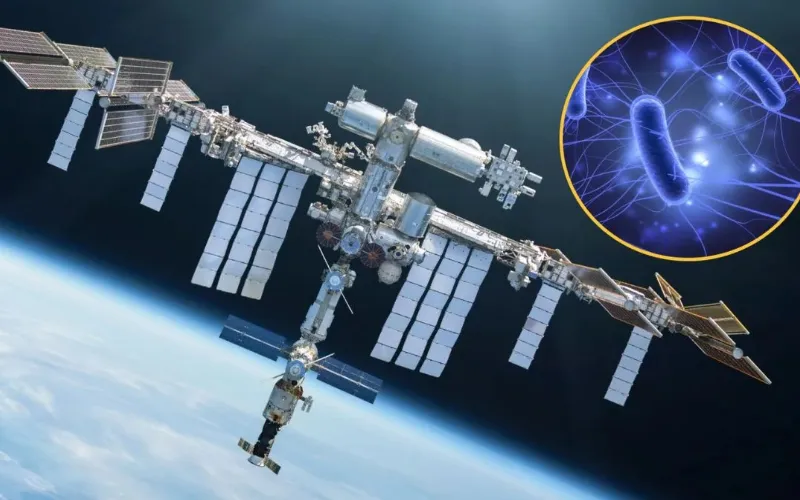
A study conducted aboard the International Space Station (ISS) has found that bacteria-infecting viruses behave differently in microgravity, a discovery that could help scientists develop new ways to combat drug-resistant infections.
Research published in PLOS Biology shows that bacteriophages viruses that target bacteria are still able to infect E. coli in near-weightless conditions.
However, both the infection process and the viruses’ evolutionary behavior differ significantly from what is observed on Earth.
The study, led by Phil Huss of the University of Wisconsin Madison, compared E. coli cultures infected with the T7 bacteriophage on Earth and aboard the ISS.
While infection in space was initially slower, the virus ultimately replicated successfully. Genetic analysis revealed that both the bacteria and the viruses developed unique mutations in the space environment.
Researchers discovered that viruses grown on the space station underwent changes in the protein they use to attach to bacteria, improving their ability to bind to bacterial cells.
At the same time, E. coli grown in space developed mutations that increased their resistance to viral attacks and enhanced their survival in microgravity.
Advanced genetic sequencing identified the specific mutations responsible for these changes. Follow-up experiments on Earth confirmed that these space-altered viruses were more effective against E. coli strains linked to human urinary tract infections, including strains typically resistant to the T7 virus.
The findings demonstrate that space-based research offers critical insights beyond understanding microbial adaptation.
Scientists concluded that microgravity reshapes virus–bacteria interactions, driving evolutionary changes that could be harnessed to engineer more powerful treatments against antibiotic-resistant bacteria on Earth.