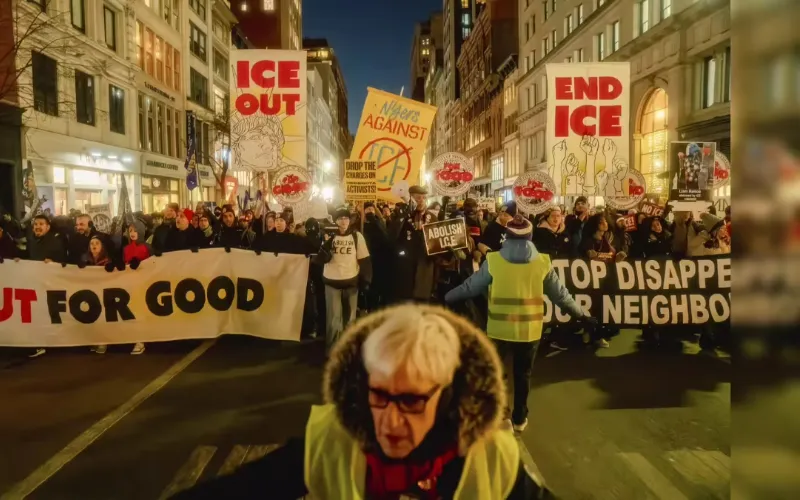
Residents, workers, and businesses across New York City are taking part in a nationwide strike Friday, calling for “no work, no school, no shopping” in protest of federal immigration enforcement operations that have resulted in at least eight deaths in the first month of 2026.
The action is part of the broader National Shutdown campaign, which emerged in response to fatalities linked to Immigration and Customs Enforcement (ICE) operations. Among those recently killed are Alex Pretti, Renée Nicole Good, Luis Gustavo Núñez Cáceres, Geraldo Lunas Campos, Víctor Manuel Díaz, Parady La, Luis Beltrán Yáñez–Cruz, Heber Sánchez Domínguez, and Keith Porter Jr., who died on December 31, 2025.
The protest comes amid the Trump administration’s intensified deportation efforts, including a massive federal operation in Minneapolis involving over 2,000 agents, which ICE has described as “the largest immigration enforcement operation ever carried out.” Local observers in Queens and Brooklyn reported ICE presence in neighborhoods leading up to the strike.
Analysis from Documented shows street arrests by ICE in New York City have risen more than 200% when comparing the last six months of the Biden administration to the first six months of President Trump’s second term.
National Shutdown Day, observed on January 30, is a call to strike and disrupt business as usual to express opposition to federal immigration enforcement operations. According to a Pew Research Center survey, 69% of Americans believe President Trump is attempting to exert more power than previous presidents.
With the tagline, “No work. No school. No shopping. Stop funding ICE,” organizers state, “The people of the Twin Cities have shown the way for the whole country—to stop ICE’s reign of terror, we need to SHUT IT DOWN. The entire country is shocked and outraged at the brutal killings of Alex Pretti, Renee Good, Silverio Villegas González, and Keith Porter Jr. by federal agents. It is time for us to all stand up together in a nationwide shutdown and say enough is enough.”
The organizers are also urging Congress to cut funding to the Department of Homeland Security, which oversees ICE, during deliberations on the current funding package, ahead of a potential federal government shutdown.
Walkouts, events, vigils, and protests are scheduled in all 50 states, including major cities such as New York City, Boston, Seattle, Los Angeles, Cleveland, Atlanta, Chicago, and Philadelphia. Locations include state capitals, federal buildings, courthouses, universities, and even some high schools. Student groups at the University of Minnesota, including the Somali Student Association, Black Student Union, and Graduate Labor Union, plan a campus walkout. “Students are always at the heart of movements for justice across the world,” they said.
Following Minnesota’s recent statewide strike, businesses nationwide including restaurants, bookstores, coffee shops, and retailers are closing or donating proceeds to immigrant rights organizations.
Grassroots organizers 50501 are calling for additional protests on Saturday, January 31, targeting ICE detention centers, offices, airports transporting ICE detainees, and some Congressional offices.
Who’s Behind National Shutdown?
National Shutdown Day is organized by a coalition of grassroots partners, including 50501, local chapters of the American Civil Liberties Union, the Defend Immigrant Families Campaign, Council on American-Islamic Relations, North Carolina Poor People’s Campaign, student groups, labor unions, and immigrant rights organizations.
The strike has also drawn attention from celebrities, including Pedro Pascal, Jamie Lee Curtis, and Edward Norton. Norton, speaking at the Sundance Film Festival, called for a national economic strike until ICE operations are halted. NYU professor Scott Galloway has similarly advocated for a prolonged general economic strike.
Despite widespread support, many residents—particularly undocumented workers and those living paycheck to paycheck—face significant barriers to participating, as doing so could risk lost wages or exposure to ICE enforcement.