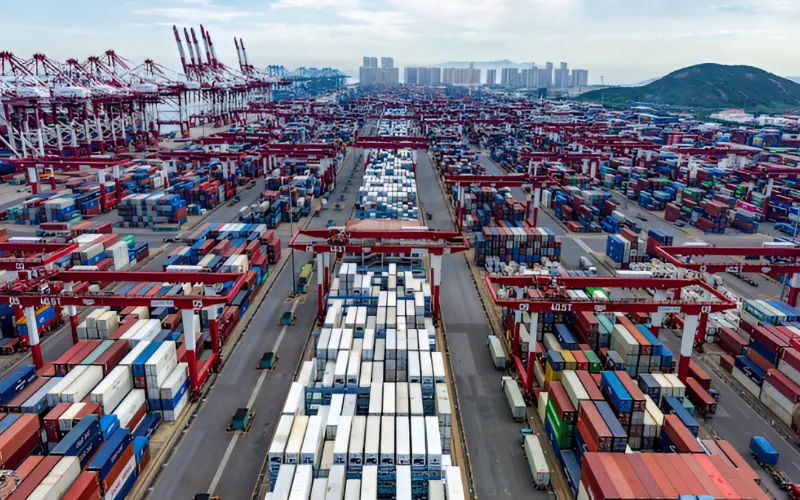
China’s exports expanded at their fastest pace in nearly five years in June, powered by soaring global demand for artificial intelligence (AI) hardware and a rush by exporters to ship goods before fresh US tariffs come into effect, underscoring the resilience of the world’s second-largest economy despite geopolitical tensions.
According to customs data released Tuesday, exports rose 27% from a year earlier in U.S. dollar terms. It was the fastest growth since October 2021, up from 19.4% in May and well above economists’ forecast of 18.2%.
During the first half of the year, China’s fastest-growing export categories were semiconductors, rare earths, automobiles and ships. Meanwhile, exports of toys, footwear, steel and furniture grew more slowly.
CNBC’s calculations based on official data showed that China’s exports to the United States increased about 14% in June, while imports from the U.S. rose 26%.
Factory activity also picked up in June as orders from the United States posted strong year-over-year growth, according to the China Beige Book. The increase also pushed freight rates higher. Manufacturers are preparing for additional tariffs from U.S. President Donald Trump under Section 301 investigations, as the current 10% broad-based tariff is set to expire July 24.
China’s exports to the United States returned to positive growth during the first half of the year after recording double-digit year-over-year declines for most of last year.
Imports rose 36% in June, marking the biggest increase since June 2021. That was higher than the 27.4% growth recorded in May and well above economists’ forecast of 24%. China’s trade surplus reached $125.6 billion in June.
Like exports, the increase in imports was mainly driven by high-tech products, while weaker demand in other categories continued to reflect sluggish domestic demand.
China continues to face a growing imbalance between supply and demand. Strong industrial production and exports linked to the global AI investment boom have supported overall economic growth, while consumer spending and private investment remain weak because of the prolonged property market downturn and fluctuating global oil prices.
Zhiwei Zhang, president and chief economist at Pinpoint Asset Management, said exports are likely to remain strong during the second half of the year. However, he warned that this could increase trade tensions between China and its trading partners, especially Europe. Last month, Beijing and Brussels established a trade and investment consultation mechanism to help rebalance bilateral trade, with European officials aiming for tangible results by October.
Customs data also showed that exports to the European Union and the Association of Southeast Asian Nations, or ASEAN, increased 18.5% and 35%, respectively, while imports from those regions rose 9% and 27%.
Another potential risk is the Russia sanctions bill proposed by the late U.S. Sen. Lindsey Graham. The bill originally proposed secondary tariffs of up to 500% on goods from countries that buy Russian oil and gas, a measure that could affect China, the largest buyer of Russian crude oil.
Lynn Song, chief economist for Greater China at ING Bank, said these factors could potentially disrupt China’s strong export performance in the coming months.