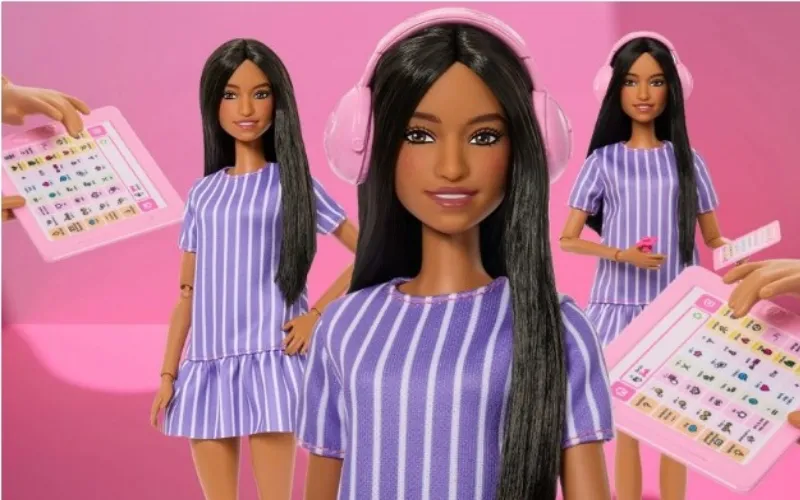
Mattel Inc. has launched its first-ever Barbie doll representing autism, a landmark initiative being hailed by advocates as a pioneering stride in authentic and meaningful representation within the world of children’s toys.
Created in partnership with the Autistic Self Advocacy Network (ASAN), the doll is the culmination of over 18 months of rigorous consultation, research, and precision design, aimed at empowering autistic children to see themselves reflected in a globally recognized icon while fostering early awareness and normalization of neurodiversity among non-autistic children.
“Noor Pervez, ASAN’s community engagement manager, said, “This doll serves as an early reinforcement a powerful visual cue for children that autistic individuals are integral, valued, and inherently normal members of society.”
View this post on Instagram
The doll’s features are meticulously designed to reflect authentic autistic traits. Its eyes are slightly averted to mirror the way some autistic individuals avoid direct eye contact.
Articulated elbows and wrists simulate stimming behaviors like hand flapping, which are often used by autistic people for sensory regulation or emotional expression.
Mattel has incorporated a fidget spinner as a sensory aid, while the doll’s wardrobe was carefully calibrated for comfort, opting for looser clothing and flat shoes to minimize sensory overload and enhance body awareness. A tablet accessory represents non-speaking autistic individuals, expanding the doll’s inclusivity.
Notably, the Barbie is intentionally designed as an autistic woman of color, emphasizing the importance of visibility for underrepresented and frequently misdiagnosed groups.
This revolutionary release signals a new paradigm in children’s toys, where inclusivity, empathy, and representation are central, empowering children of all abilities to embrace diversity and celebrate neurodiversity from an early age.