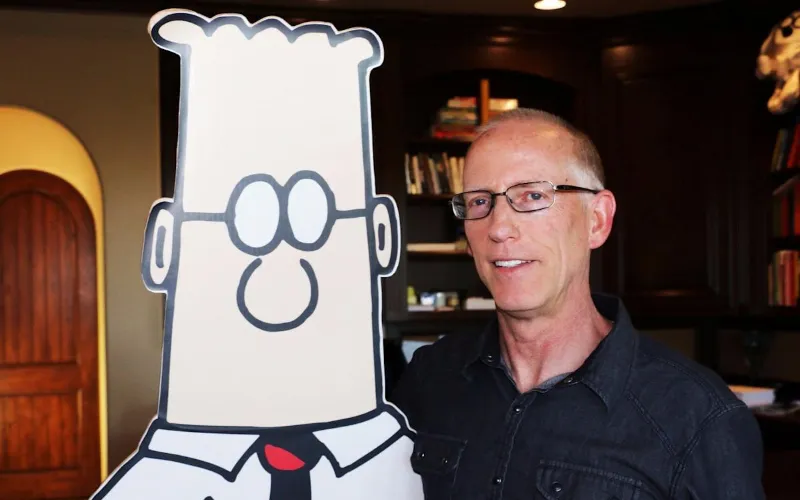
One of the most enduring observers of corporate loneliness has fallen silent. Scott Adams, the creator of the legendary comic strip Dilbert, has died at the age of 68 after losing a harrowing battle with metastatic prostate cancer.

His death draws a somber close to a voice that, for decades, distilled office frustration into dry humor and gave identity to the quiet exhaustion of working life.
The news of Adams’ passing was confirmed by his former wife, Shelly Miles, during an episode of his longtime livestream Coffee with Scott Adams.
Adams had disclosed in May 2025 that he was suffering from an aggressive form of prostate cancer and had been given only a limited time to live. In his final weeks, his health deteriorated rapidly, and he spent his last days receiving end-of-life care at home.
Shortly after his death, a final message written by Adams on New Year’s Day was shared on his social media platforms. “I had an amazing life,” he wrote. “I gave it everything I had. If any good comes from my work, I hope you’ll pay it forward. That’s the legacy I want. Be useful, and please know I loved you all to the very end.”

First appearing in newspapers in 1989, Dilbert evolved into a defining satire of American corporate culture throughout the 1990s. Its minimalist design and sharp observations captured the absurdities of bureaucracy, incompetent management, and soulless office routines.
At its height, the strip was syndicated globally, earning Adams the National Cartoonists Society’s Reuben Award in 1997.
A native of New York, Adams infused his work with real-life experience. He worked as a bank teller before earning an MBA from the University of California, Berkeley, later joining Pacific Bell as an engineer.
The sterile environments and baffling hierarchies he encountered there became the backbone of Dilbert’s universe, populated by aimless meetings and the infamous pointy-haired boss.
Despite its long success, Adams’ career collapsed in early 2023 following racist remarks he made about Black Americans during a livestream.
The comments ignited swift condemnation, leading hundreds of newspapers to drop Dilbert within days and bringing its mainstream syndication to an abrupt end.

Adams later claimed his statements were exaggerated and misunderstood, saying he rejected racism. Nevertheless, the controversy irreversibly reshaped his public reputation.
He continued the comic independently under the title Dilbert Reborn, offering subscribers a more unrestrained version of the strip.
In his later years, Adams became increasingly visible for his conservative political views and vocal support of President Donald Trump, who later paid tribute to him, calling Adams “The Great Influencer.” Billionaire Elon Musk also publicly defended Adams following the backlash.
Declining health further constrained his creative output. In late 2025, Adams stopped drawing Dilbert himself due to severe cramping and partial paralysis in his hands, though he continued to write scripts that were illustrated by others.

Beyond comics, Adams ventured into several business projects, including a short-lived restaurant chain and the discontinued “Dilberito,” a frozen vegetarian burrito. While these efforts failed commercially, Dilbert remained his lasting legacy.
In later reflections, Adams described himself as a “disgraced and canceled cartoonist.” Still, his work endures as a sharp chronicle of workplace disillusionment. For generations of readers, Dilbert was not just a comic it was recognition, relief, and reflection.