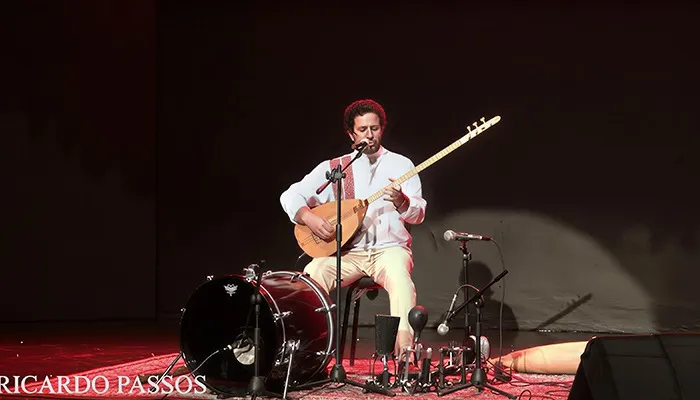
As Portuguese multi-instrumentalist Ricardo Passos took his place on the stage at Alhamra Arts Council, it felt as though time itself had paused allowing centuries of musical traditions from across the world to converge into a single, sacred space.
What followed was far more than a concert, it was a deeply immersive experience that transcended geography, dissolving borders through the universal language of sound.
Ricardo Passos arrived in Pakistan not merely carrying an extraordinary collection of rare instruments, but accompanied by decades of travel, introspection, and an almost spiritual bond with music.
His short yet meaningful journey through Karachi and Lahore echoed a life shaped not by destinations, but by resonance, memory, and breath.
On stage, he appeared as a modern musical wanderer someone who believes that every instrument carries its own history, and every melody preserves fragments of ancient worlds. He opened the performance with the haunting voice of the Armenian duduk, its mournful tones settling gently over the hall.
Without hesitation, the sound transformed into the soft warmth of a Brazilian wooden flute, before the delicate, shimmering notes of Zimbabwe’s mbira filled the silence like distant starlight.
As the journey unfolded, Passos summoned the grounded, earthy resonance of Gabon’s ngombi, followed by the sharp yet poetic elegance of the Turkish saz, played with the tenderness of a long-cherished companion. Each transition felt organic guided by intuition rather than structure, emotion rather than convention.
There was no rigid sequence, only flow. Breath turned into rhythm, silence became space, and raga-inspired tonal explorations drifted effortlessly between cultures. In those moments, geography ceased to exist.
The audience listened in near-reverent stillness, afraid that even the faintest sound might disrupt the fragile beauty of the unfolding experience.
When the final note faded and applause filled the hall, it was evident that Alhamra had not merely hosted a performance it had welcomed a storyteller. A musician who navigates through emotion rather than maps, and memory rather than melody alone.
Born in Porto in 1977, Ricardo Passos has spent more than two decades tracing musical lineages across Asia, Africa, the Americas, and Europe.
Prior to his Lahore performance, he appeared at Karachi’s World Culture Festival and conducted a workshop at the National College of Arts, leaving a subtle yet lasting impression on Pakistan’s creative community.
Though brief, his visit marked a significant chapter in what he describes as a lifelong quest to uncover the invisible threads linking global sound traditions. In Lahore, those threads seemed to converge, granting the evening a rare sense of completeness.
“For me, everything began with music,” Passos shared with PTV Digital. “But along the way, I realised it was leading me back to myself.” His words reflected wisdom cultivated through experience, not haste.
By classical standards, his musical path began later than most. In Portugal, Passos first performed guitar in rock bands before formally studying Western classical piano and guitar at a conservatory.
His worldview shifted dramatically, however, following a formative journey to Morocco during his teenage years a moment he describes as one of profound inner awakening.
That journey ignited what he calls “a call from the soul,” drawing him toward musical traditions beyond Western frameworks. Travel soon became both his education and personal exploration.
In his early twenties, he left Portugal, never to return permanently. The road became his mentor; each culture, a new chapter.
“What followed was never planned,” he reflected during a Karachi interview days earlier. “Life kept opening paths. I simply listened and everything connected. Ancient traditions have always felt strangely familiar to me.”
His curiosity led him across Spain, India, Turkey, and deep into Africa, where he studied instruments rarely encountered in European institutions. In India, he spent years immersed in Dhrupad, a discipline that profoundly reshaped his understanding of breath, voice, and time.
These experiences culminated in the performance he presented in Pakistan. Despite limited time to explore Karachi, he felt instantly embraced by the city’s creative energy.
With intention and preparation, he arrived eager to perform with the ngombi, now among the most meaningful instruments of his life. He plans to return to Gabon next year to deepen his study of it.
“People often expect me to perform traditional Portuguese music,” he said with a quiet smile. “But I don’t even though I am Portuguese. You could say I exist outside the box. My music belongs to the world.”
Ricardo Passos also expressed admiration for Pakistani instruments. The raw vitality of the dhol captivated him, while the depth of the rubab stirred his curiosity after witnessing local musicians perform at the festival.
Pakistan, he said, offered sounds he hopes to explore further. Even within just two hurried days, he sensed an openness of spirit that resonated deeply with the curiosity that has guided his life for over three decades.
In the coming months, Ricardo Passos will return to Portugal for performances, then continue on to Brazil and beyond, wherever the next invitation arises. His life, much like his music, remains free-flowing guided by intuition, movement, and the quiet pull of sound.