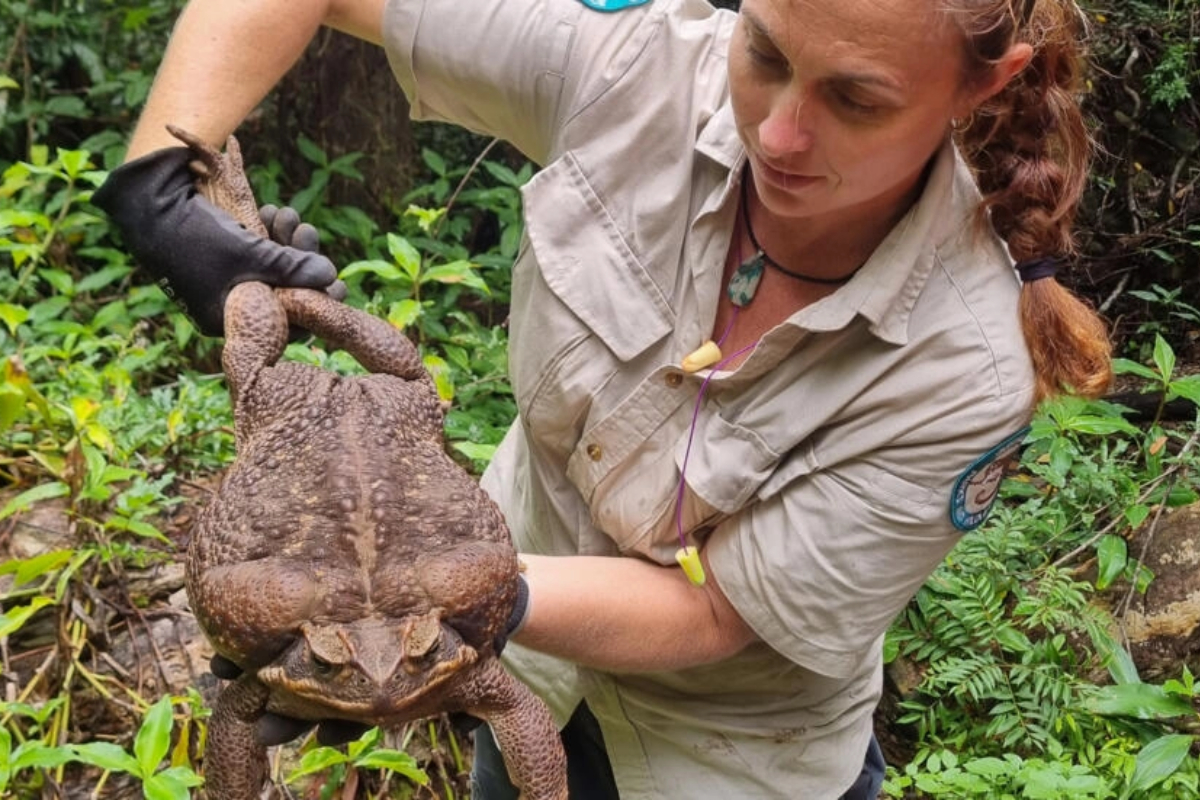
- An invasive cane toad that was as long as a human arm and 2.7 kilos in weight was destroyed by rangers.
- Cane toads were introduced into Queensland in 1935, which had disastrous effects on the local wildlife.
- The species can survive up to 15 years in the wild.
An invasive “monster” cane toad that was found in the wild of an Australian coastal park and was as long as a human arm and 2.7 kilos (6 pounds) in weight was destroyed by rangers.
Wildlife workers were travelling through Queensland’s Conway National Park when they came upon the toad after being forced to halt by a snake crawling over the track, according to the state government.
“I reached down and grabbed the cane toad and couldn’t believe how big and heavy it was,” ranger Kylee Gray said, describing how she discovered the amphibian last week.
“A cane toad that size will eat anything it can fit into its mouth, and that includes insects, reptiles and small mammals,” she said.
The animal was removed and put to death.
[embedpost slug = “/wildlife-reserve-in-southern-china/”]
To combat the cane beetle, cane toads were introduced into Queensland in 1935, which had disastrous effects on the local wildlife.
According to a statement from the Queensland Department of Environment and Science, the toad may set a record of 2.7 kilos, which is almost the weight of a newborn human child.
The department called it a “monster” and suggested it might wind up in the Queensland Museum.
The rangers think it was a female because of its size.
Gray stated that even though the age is unknown, “this one has been around for a long time,” adding that amphibians can survive up to 15 years in the wild.
Cane toad females can lay up to 30,000 eggs in a season, and the creatures are so venomous that several of its native predators have been driven extinct.
[embedpost slug=”/india-tiger-cull-controversy-in-kerala/”]