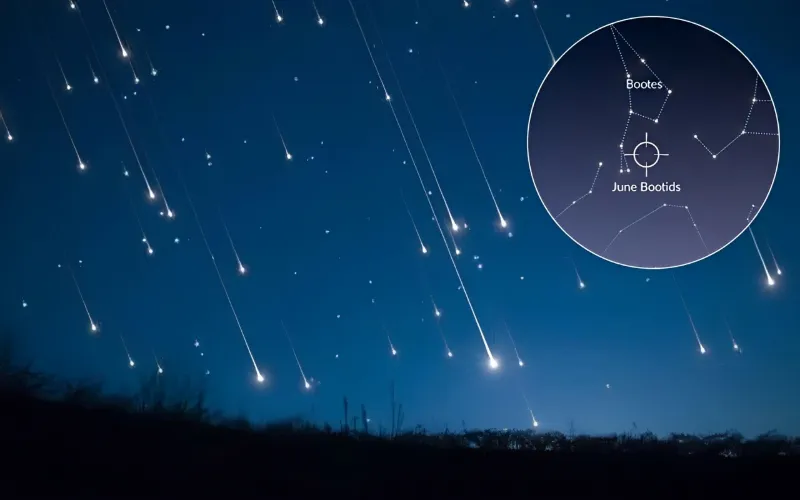
The June Bootids meteor shower will appear in the sky every year from June 22 to July 2.
This year, it is expected to reach its peak around June 27. Most meteor showers follow a steady pattern, but the Bootids are known for sudden and unpredictable bursts of activity.
Early forecasts suggest that this year may bring only weak activity. Experts say a small peak could happen around June 22. The International Meteor Organization also notes that earth is not currently moving through the same dense debris streams that caused major displays in the past.
You could see up to 100 meteors per hour this month! 🌠
The Bootids are active now until July 2, and will peak on June 21. This meteor shower varies, with some years producing just a few meteors in an hour, and others getting up to 100 per hour! Scientists are unable to predict… pic.twitter.com/X0RGbt6HF9
— Museum of Science (@museumofscience) June 17, 2026
The June Bootids have a history of surprising sky watchers. In 1998, people saw a strong outburst with up to 100 meteors per hour, and this activity continued for several hours. In 2004, another burst produced around 20 to 50 meteors per hour. However, in 2010, the shower was much weaker, with fewer than 10 meteors per hour.
This meteor shower happens when earth passes through dust and small particles left behind by comet 7P/Pons-Winnecke. This comet travels around the Sun roughly every six years.
As the debris enters earth atmosphere, it burns up at about 18 kilometers per second. This speed is slower than many other meteor showers, so the streaks often look longer and smoother in the sky.
To watch the June Bootids, people should find a dark place away from city lights. It is important to give the eyes about 20 minutes to adjust to darkness for better visibility.
The best direction to look is toward the constellation Bootes, which appears in the western and southwestern sky, sky watchers are advised to scan a wide area instead of focusing on one point.
Although summer nights are short, clear skies in many regions may still give people a chance to see the meteor shower.