Pakistan’s Federal Interior Minister, Mohsin Naqvi, has initiated an important and timely national initiative by calling upon all political parties to engage in meaningful dialogue on the creation of new administrative units and provinces. His proposal for national consensus of all political parties on an issue of profound constitutional, administrative, and developmental significance deserves serious, objective, and consideration.
History demonstrates that nations achieve lasting progress not merely by increasing their wealth or natural resources but by continuously reforming their institutions to meet the changing realities of the global economic development and Administrative systems that served a nation effectively decades ago often become inadequate as populations growth, economies diversify, cities expand, technology advances, and citizens’ expectations evolve. Successful countries periodically modernize their governance structures to ensure that government remains efficient, transparent, accountable, and accessible to every citizen.
Pakistan today stands at precisely such a defining moment.
With a population exceeding 250 million, rapid urbanization, expanding infrastructure, increasing economic complexity, evolving security challenges, climate induced disasters, and rising public expectations, Pakistan’s administrative framework, service providers are under unprecedented pressure. Several provinces today govern populations larger than those of many sovereign nations, making efficient administration, effective supervision, and equitable development increasingly difficult.
It is against this backdrop that Interior Minister Mohsin Naqvi has advocated the creation of new administrative units and provinces not as a political exercise, but as a long overdue governance reform designed to decentralize authority, improve public service delivery, and bring government closer to the people.
This proposal should not be viewed through political, ethnic, or linguistic lenses. Rather, it should be examined as a comprehensive constitutional and administrative reform aimed at strengthening governance, deepening democracy, accelerating economic growth, ensuring balanced regional development, improving public service delivery, and reinforcing national integration.
Administrative boundaries are not immutable. Throughout history, they have evolved alongside demographic, economic, and social transformations. Nations that fail to modernize their institutions often experience bureaucratic inefficiency, regional disparities, slow economic growth, and declining public confidence. Conversely, countries that adapt their governance systems to changing realities are better positioned to achieve sustainable development.
Pakistan must choose institutional reform over administrative stagnation.
Administrative Reform: A Prerequisite for Good Governance
Good governance depends upon institutions that are capable of serving people efficiently. As populations expand and administrative responsibilities multiply, governance naturally becomes more difficult unless administrative structures are strengthened accordingly.
The creation of new administrative units and provinces would reduce the excessive burden currently placed upon provincial governments, enabling faster decision making, improved coordination among departments, enhanced supervision of development projects, and greater accountability.
Most importantly, decentralization would bring government much closer to ordinary citizens, allowing them easier access to public institutions, courts, police, healthcare facilities, educational institutions, revenue departments, and municipal services.
Government exists to serve the people. The closer government is to its citizens, the more responsive, transparent, and effective it becomes.
Learning from International Best Practices
The proposal and initiative to create new administrative units and provinces is neither unprecedented nor experimental.
Many of the world’s most successful federations have periodically reorganized their internal administrative structures in response to demographic growth and evolving governance requirements.
India has created numerous new states since independence to improve administration and ensure balanced regional development. Indonesia has repeatedly established new provinces and districts to strengthen governance across its vast territory. Nigeria expanded from three regions to thirty six states to improve administrative efficiency and political representation. Likewise, Brazil, Germany, South Africa, Ethiopia, Australia, and Canada have all refined their administrative structures to improve governance and public service delivery.
These examples demonstrate a universal principle: governance systems must evolve alongside national development.
Administrative restructuring is therefore a hallmark of institutional maturity not political instability.
Pakistan should confidently learn from these successful international experiences while ensuring that any reforms remain fully consistent with its Constitution, democratic traditions, and federal principles.
Strengthening the Federation Through Decentralization
Contrary to common misconceptions, creating new administrative units and provinces would strengthen rather than weaken Pakistan’s federation.
Smaller, more manageable administrative units improve governance by bringing public institutions closer to citizens, reducing regional disparities, and ensuring that every area receives adequate administrative attention.
Balanced regional development strengthens national cohesion because citizens who receive equitable opportunities and quality public services develop greater confidence in democratic institutions.
A strong federation is not built through excessive centralization; rather, it is built through effective decentralization, equitable development, and responsive governance.
Economic Growth Requires Administrative Efficiency
Efficient administration is indispensable for sustainable economic growth.
Investors require transparent regulations, timely approvals, efficient infrastructure, reliable public services, and responsive government institutions.
Administrative bottlenecks, excessive bureaucracy, and delayed decision making discourage investment and increase the cost of doing business.
The creation of new administrative units and provinces can significantly improve the investment climate by streamlining governance, accelerating infrastructure development, improving regulatory coordination, and strengthening local economic planning.
Administrative reform is, therefore, not merely a governance issue, it is an economic imperative.
A Historic Opportunity for Political Consensus
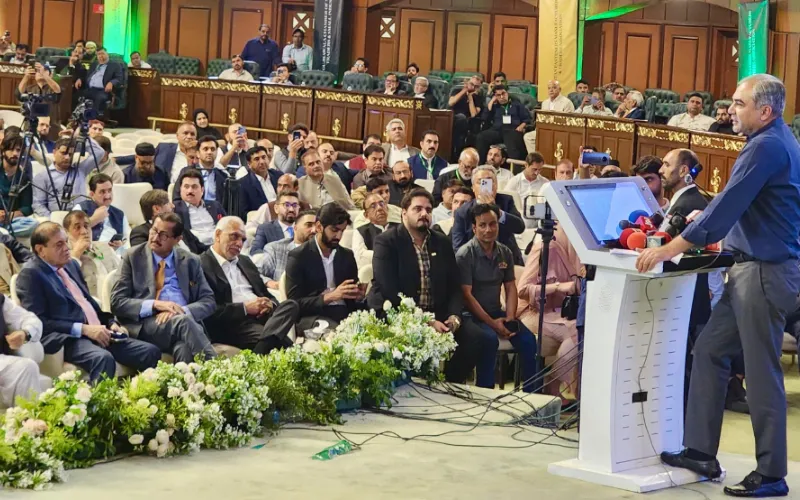
Perhaps the most significant aspect of Mohsin Naqvi’s speech is his emphasis on dialogue and national consensus.
Constitutional reforms of such importance cannot and should not be imposed by any single government or political party. They require thoughtful parliamentary deliberation, constitutional safeguards, and broad based agreement among all stakeholders.
This presents a historic opportunity for all political parties, provincial governments, constitutional experts, economists, jurists, academics, civil society representatives, and public policy specialists to rise above partisan politics and jointly design a modern governance framework capable of meeting Pakistan’s future needs.
This framework will unite the nation around the shared objective of better governance and improved public service delivery not divide it along political, ethnic, or regional lines.
The objective is not to create additional political offices or expand bureaucracy. Rather, it is to establish an efficient administrative system capable of delivering faster justice, quality healthcare, better education, employment, effective policing, modern municipal services, efficient disaster management, balanced regional development, and expanded economic opportunities for every Pakistani.
Building the Pakistan of Tomorrow
Administrative reform is ultimately an investment in future generations.
The Pakistan envisioned under the principles of good governance, a prosperous, digitally connected, economically competitive, and globally respected nation cannot continue to rely indefinitely on administrative structures designed for a vastly different demographic and economic environment.
Future generations deserve institutions that are modern, efficient, transparent, accountable, and citizen centric.
The creation of new administrative units and provinces represents far more than the redrawing of geographical boundaries; it signifies the modernization of the state itself and the establishment of institutions capable of addressing the complex future challenges.
Conclusion
Pakistan has reached a stage where comprehensive administrative reform is no longer a matter of choice, it has become a national necessity.
Federal Interior Minister Mohsin Naqvi has very rightly and timely initiated a visionary approach that deserves serious national attention. His proposal reflects internationally recognized principles of decentralization, institutional modernization, and good governance that have enabled many countries to improve administrative efficiency, strengthen democratic institutions, and accelerate socioeconomic development.
The time has come for all political parties, irrespective of ideology or provincial affiliation, to engage in constructive dialogue and build a broad national consensus on the creation of new administrative units and provinces. Any reforms must be guided by constitutional principles, objective administrative criteria, economic viability, demographic realities, administrative efficiency, and, above all, the national interest.
If implemented through transparency, constitutional consensus, and careful planning, the creation of new administrative units and provinces could become one of the most significant governance reforms in Pakistan’s history. It would bring government closer to the people, improve public service delivery, promote balanced regional development, strengthen democratic institutions, attract investment, generate employment, and reinforce national unity.
The strongest nations are those that possess the foresight to reform their institutions before circumstances compel them to do so.
For Pakistan, the creation of new administrative units and provinces is not merely an administrative adjustment, it is the need of the hour, a strategic investment in good governance, and an essential step towards building a stronger, more efficient, more united, and more prosperous Pakistan for present and future generations.