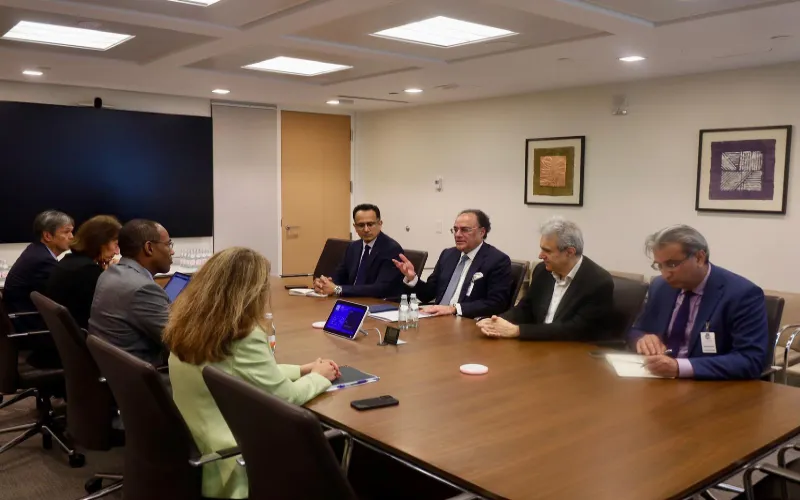
ISLAMABAD: Pakistan is positioning itself to become a leader in artificial intelligence (AI) and robotics by developing indigenous technological capabilities, Federal Minister for Information Technology and Telecommunication Shaza Fatima Khawaja said on Wednesday.
Addressing the two-day Indus RAS (Robotics and Autonomous Systems) Expo 2026, the minister said technological self-reliance has become a national priority, with the government committed to building the full value chain of AI and robotics under its Digital Nation Pakistan vision.
“Pakistan will own the full value chain of robotics and artificial intelligence because achieving advanced technological self-reliance is a national decision, and the country is now ready to realise that vision,” she said.
Shaza Fatima said the government, under the leadership of Prime Minister Muhammad Shehbaz Sharif, is placing technology at the heart of economic growth, employment and national competitiveness, adding that digital transformation is no longer optional but essential for future development.
Read More: IT Minister Shaza Fatima clarifies Telecom Bill, says private land cannot be used without consent
She said the world is transitioning from the digital era to the intelligent era, with artificial intelligence increasingly becoming the foundation of value creation.
Robotics, she added, is expanding beyond factories into warehouses, agriculture, transportation, critical infrastructure, disaster response and national security.
According to the minister, countries that lead in AI and robotics will shape the future global economy, while those relying solely on imported technologies will remain dependent on others. “Pakistan has chosen to lead,” she said.
Highlighting recent government initiatives, Shaza Fatima said Prime Minister Shehbaz Sharif had launched an AI-enabled, evidence-based Prime Minister’s Office system to modernise governance and improve decision-making through technology.
She also said Pakistan’s defence leadership has transformed the military into a cyber-centric institution, while the Ministry of IT and Telecommunication continues to invest in digital infrastructure, innovation ecosystems, entrepreneurship, startups, digital skills and emerging technologies.
“We are creating an environment where innovators can build, startups can scale, investors can grow, young Pakistanis can compete globally and, most importantly, where the government serves as the ultimate enabler,” she said.
The minister said Pakistan’s ICT exports grew by nearly 21% this year, reflecting the resilience of the technology sector and the effectiveness of government policies.
She also highlighted improvements in global rankings, saying Pakistan now ranks among the top-performing countries in cybersecurity according to the International Telecommunication Union (ITU). She added that the country has climbed 14 places in the E-Government Development Index and 27 places in the ITU ICT Development Index.
Calling artificial intelligence the defining technology of the current generation and robotics its physical extension, Shaza Fatima said Pakistan’s goal is not only to adopt these technologies but also to develop local expertise and innovation that will strengthen economic growth and safegu
rd national sovereignty.
She said technological leadership has become a key measure of national strength, stressing that investing in indigenous AI and robotics capabilities is essential for Pakistan’s long-term competitiveness and self-reliance.