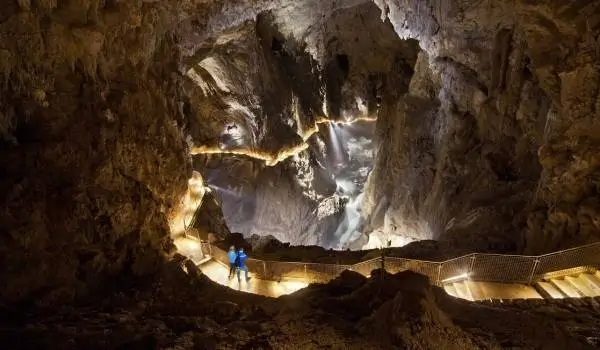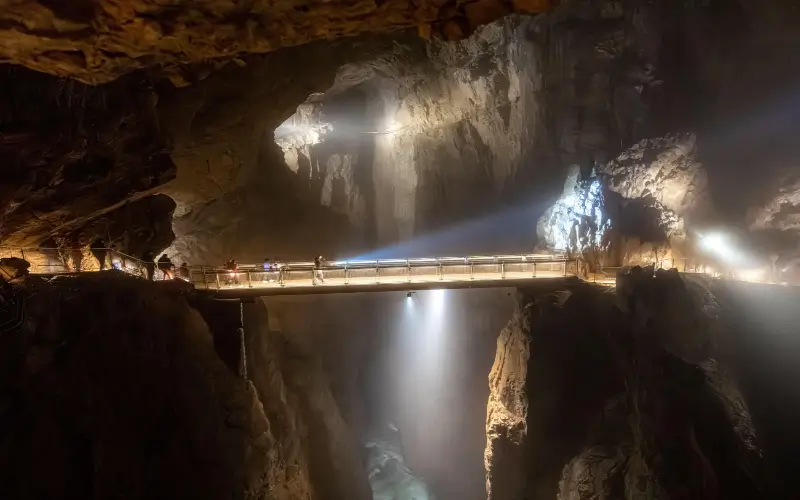
The lights suddenly go off, and everything disappears into complete darkness. There is only silence, the soft sound of dripping water, and a strange feeling of unease. When the lights come back on, the hidden underground world of the Karst appears again.
This moment happens inside Vilenica Cave, believed to be the first cave in the world opened to tourists, with visitor records dating back to 1633. The cave feels almost magical, with a vast entrance chamber shaped by erosion, tall stalagmites rising from the ground, stalactites hanging from the ceiling, and colors of red, orange, and terracotta created by iron oxide, along with sparkling crystals.
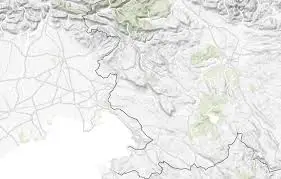
Vilenica is only one of thousands of caves spread across the Karst region, which lies between western Slovenia and eastern Italy. The area is famous for its limestone rock that dissolves easily. On the surface, this creates a rugged landscape marked by striped rocks and deep hollows called dolines, formed when the ground collapses.
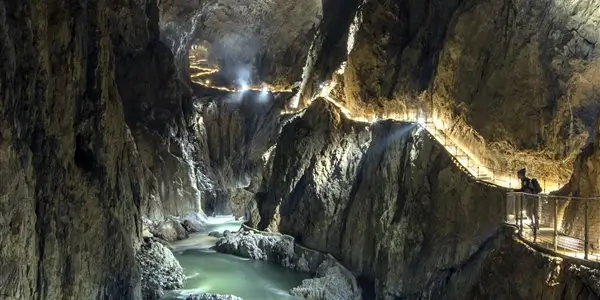
Underground, however, the region is even more impressive, with massive caves, sinkholes, and underground rivers. Later, a visit to the Škocjan caves reveals a powerful river flowing through a cavern nearly 150 meters high, creating a dramatic and almost unreal experience as the sound of rushing water echoes through the space.
Driving through the Karst, rolling hills and quiet countryside stretch into the distance. Small villages appear along the road, many with bilingual signs, reflecting the shared history of Italy and Slovenia and a border that changed several times during the 20th century.
Today, the area increasingly sees itself as one united region. It aims to avoid the overcrowding faced by more famous destinations in both countries by attracting travelers who want a slower, more authentic experience. To highlight its shared culture, history, and nature, the region has created a new EU-funded cross-border geopark called GeoKarst and hopes to gain Unesco recognition.
One of the most striking places is Štanjel, a medieval village that looks similar to those in Provence but without the crowds. Walking through its stone streets feels like stepping back hundreds, even thousands, of years, as the village has roots going back to prehistoric and Roman times.
The grey stone buildings, made from local Karst stone, have remained largely unchanged for centuries. At sunset, sitting with a glass of local vitovska wine in a small restaurant decorated with dried flowers, the view of the golden valley below feels calm and timeless.
Crossing into Italy, the Karst meets the city of Trieste, a lively university town where Italian culture blends with Viennese-style architecture from its past as the main port of the Austro-Hungarian Empire. Locals say this mix has made the city more open and tolerant. A guide explains that in Trieste, unlike much of Italy, people feel comfortable eating or drinking alone without being judged. Older generations still feel a strong connection to Austria, often saying life was better during that time.
People in Trieste also love how close nature is. Just 15 minutes from the city center is the Via Napoleonica trail, a three-mile path with wide views over the bay. It connects the towns of Opicina and Prosecco, where the famous sparkling wine gets its name.
Food in the Karst region is deeply tied to local farming. Most ingredients come from nearby producers, and a special local tradition is visiting osmice, which are family-run farms and vineyards.
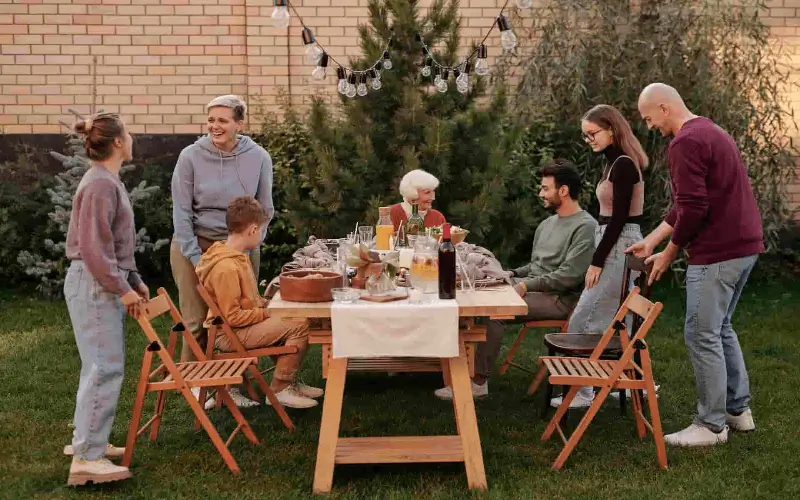
At places like Cantina Parovel, visitors are served homemade cheese, wine, prosciutto, honey, and olive oil at simple picnic tables under pine trees. The family proudly shares their history, explaining how three generations were born in the same village, yet lived under different countries, from the Austro-Hungarian Empire to Italy and now Slovenia.
Their farm sits at the end of a scenic four-mile hike through the Rosandra Valley, following part of the Alpe Adria Trail. The path passes wild cherry trees and roe deer, and sometimes hikers come across small “wine caves,” where locals leave wine and cheese for travelers to enjoy and pay for honestly, with simple wooden seats overlooking the valley.
This experience captures what makes the Karst region special: a dramatic natural landscape and a warm, welcoming sense of community that crosses borders.