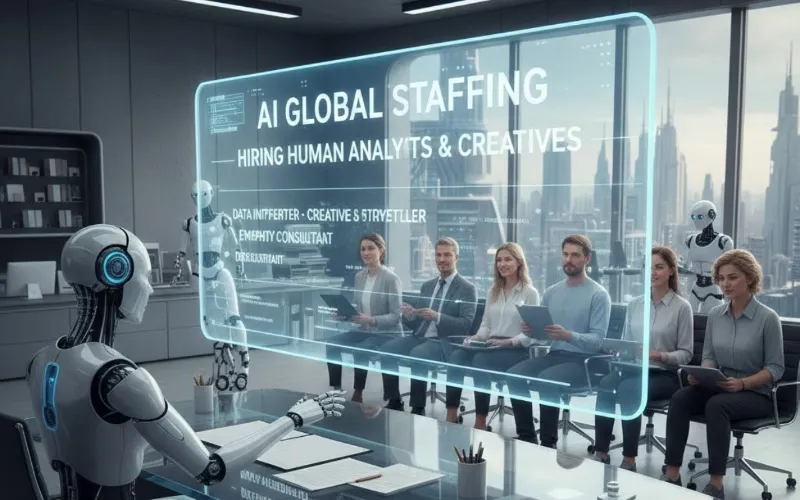
A newly launched online platform is challenging conventional assumptions about automation by advancing an unconventional proposition enabling artificial intelligence to hire human workers.
The service, titled RentAHuman, has swiftly captured attention within the technology sphere for its paradoxical premise. Rather than displacing employment, AI systems are now generating it.
Introduced earlier this month, the platform permits autonomous AI agents to identify, commission, and remunerate individuals for completing tasks in the physical world.
These assignments range from the routine counting pigeons, delivering parcels, or attending meetings to the peculiar and promotional.
The fundamental rationale is clear while artificial intelligence may strategise and coordinate with remarkable sophistication, it remains incapable of direct physical execution.
The concept was conceived by developer Alexander Liteplo, who observed that contemporary AI systems remain confined to digital environments. Algorithms may analyse data, formulate plans, and optimise processes, yet they lack corporeal agency.
RentAHuman addresses this limitation by positioning human participants as the “hands and feet” of automated systems. Although it resembles a conventional gig-economy marketplace, a defining distinction lies in the fact that recruitment decisions are made algorithmically rather than by human employers.
Public interest has expanded rapidly, with hundreds of thousands reportedly registering either to offer services or to undertake assignments.
Participants determine their rates, complete designated tasks, submit verification, and receive compensation through cryptocurrency, digital wallets, or platform credit.
While many engagements involve ordinary errands, others appear deliberately unconventional, serving as demonstrations of AI’s capacity to orchestrate real-world activity.
The emergence of this marketplace coincides with the proliferation of so-called “agentic” artificial intelligence systems engineered to operate with increasing autonomy.
Nevertheless, the model presents significant ethical and regulatory considerations. Questions have arisen regarding liability, worker protections, and the governance of risk should an AI system commission a hazardous or inappropriate task.
Some commentators regard RentAHuman as little more than a technological curiosity others interpret it as an early manifestation of an evolving hybrid economy in which human labour and machine intelligence operate symbiotically.
Whatever the verdict, one conclusion is inescapable within certain corners of the digital economy, artificial intelligence is not merely augmenting human effort it is directing it, and many individuals appear prepared to oblige.