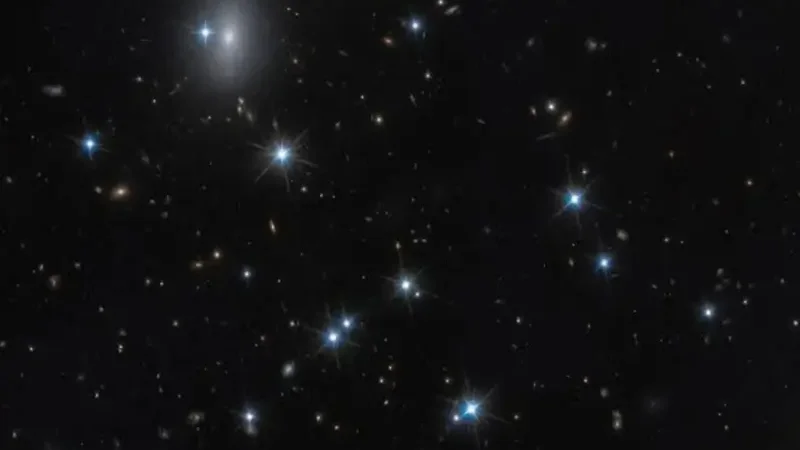
Astronomers have discovered a very faint and almost invisible galaxy that appears to be dominated by dark matter. The object, known as Candidate Dark Galaxy‑2 (CDG-2), is located about 300 million light-years away from Earth in the Perseus Cluster. Scientists identified the galaxy while studying data from several space observatories, including the Hubble Space Telescope.
The discovery was made by researchers from the University of Toronto and other institutions. Their findings were published in The Astrophysical Journal Letters. The team detected the galaxy by studying globular clusters and the gravitational effects around them, which helped reveal the presence of a hidden galaxy and provided new clues about dark matter and the evolution of the universe.
Scientists believe that CDG-2 is made up of about 99.9 percent dark matter. Dark matter is an invisible substance that cannot be seen directly, but its gravity influences the movement and structure of galaxies in the universe. Researchers estimate that dark matter is about five times more common than normal matter.
According to Dayi Li, a postdoctoral fellow at the University of Toronto, the object can be described as an “almost-dark galaxy.” He explained that CDG-2 belongs to a group of galaxies with extremely low brightness and almost no visible stars. In comparison, our galaxy, the Milky Way, is around 20,000 times brighter.
To locate CDG-2, scientists analyzed data from several powerful observatories, including the Euclid mission of the European Space Agency and the Subaru Telescope in Hawaii. Instead of searching for hydrogen gas, researchers focused on globular clusters, which are dense groups of very old stars. They eventually found four clusters surrounded by a faint halo, suggesting the presence of a hidden galaxy.
Scientists think that the galaxy may have once contained gas needed to form new stars. However, larger nearby galaxies may have pulled that gas away, leaving behind mostly dark matter along with a few star clusters. This discovery could help researchers better understand how galaxies evolve and how dark matter shapes the universe.