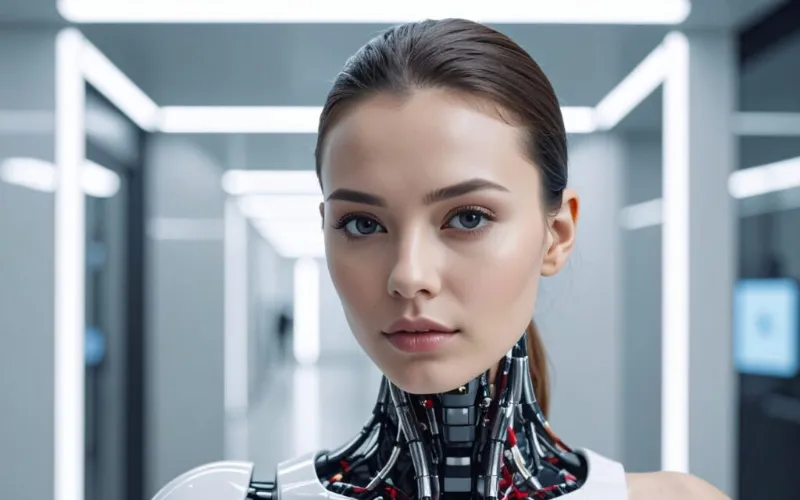
A highly advanced demonstration video released by a Chinese robotics startup has gone viral, showcasing a hyper-realistic humanoid robot face that has sparked widespread comparisons to science-fiction narratives such as Westworld.
The footage was shared by AheadForm, a China-based robotics and artificial intelligence company founded in 2024, which is focused on developing next-generation humanoid platforms that integrate AI-driven perception systems with biomimetic mechanical design to enable natural human-robot interaction.
The robot, named AheadForm Origin M1, is equipped with an adaptive facial actuation architecture, featuring dynamic eye tracking, autonomous blinking, and synchronized speech articulation.
According to the company, these capabilities allow the system to interpret and respond to human non-verbal communication signals, significantly enhancing realism and engagement.
The viral clip highlights only the robot’s facial module, revealing high-fidelity micro-expressions, rapid ocular movement, and fluid muscle simulation that closely replicate human facial behavior.
AheadForm states that the Origin M1 utilizes a multi-axis facial control system powered by up to 25 precision micro-motors, enabling fine-grained control over facial deformation and emotional expression.
AheadForm’s development roadmap also includes a range of humanoid platforms under its “Lan Series,” alongside a stylized humanoid model known as ELF V1, reflecting the company’s exploration of both functional and character-based robotic design.
In a previous interview with the South China Morning Post, AheadForm founder Hu Yuhang outlined the company’s long-term vision, predicting that within the next decade, human-robot interaction may reach a level of near-human behavioral realism.
He further projected that within 20 years, humanoid robots could achieve bipedal locomotion stability, dexterous manipulation, and task execution comparable to human capabilities.
As the video continues to circulate across digital platforms, it has intensified global discussion around the rapid convergence of artificial intelligence, robotics, and human-machine interface technologies, raising questions about how close society is to a future once confined to science fiction.