Nvidia has reached a historic agreement with artificial intelligence chip startup Groq, committing nearly $20 billion in a deal that marks the largest transaction in the company’s history.
The move signals Nvidia’s growing ambition to dominate the rapidly evolving AI hardware landscape.
Founded in 2016 by former Google engineers, including TPU co-creator Jonathan Ross, Groq has built a reputation for designing next-generation AI accelerator chips that specialize in low-latency inference, a critical requirement for real-time and large-scale AI applications.
Despite the massive valuation, Groq clarified that the arrangement is not a full acquisition. Instead, the agreement is structured as a non-exclusive licensing deal, allowing Nvidia to integrate Groq’s inference technology into its own AI systems while Groq remains an independent company.
As part of the deal, Groq founder Jonathan Ross, company president Sunny Madra, and several senior industry leaders will join Nvidia. Groq will continue its operations under newly appointed CEO Simon Edwards, ensuring continuity in its independent roadmap.
Notably, GroqCloud, the company’s cloud computing arm, is excluded from the transaction and will operate separately.
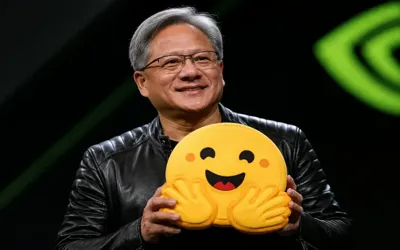
Nvidia CEO Jensen Huang said the agreement will enable Nvidia to incorporate Groq’s ultra-low-latency chipsets into its AI factory architecture, significantly enhancing performance and efficiency.
He stressed that Nvidia is licensing intellectual property and acquiring top-tier talent, rather than purchasing the company itself.
The deal far exceeds Nvidia’s previous largest acquisition the $7 billion Mellanox purchase in 2019 and reflects the company’s growing financial strength, with cash reserves standing at $60.6 billion as of October.
This strategic move highlights Nvidia’s determination to strengthen its AI ecosystem amid intensifying competition in the global AI chip market, as demand for faster and more efficient inference solutions continues to surge.