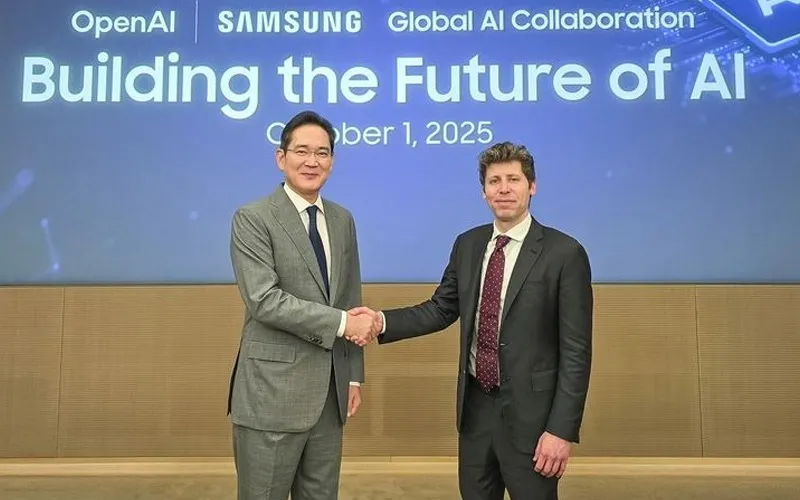
OpenAI will provide its ChatGPT Enterprise platform and AI coding assistant Codex to Samsung Electronics employees worldwide, as part of the South Korean tech giant’s company-wide strategy to accelerate its artificial intelligence transformation.
Under the agreement, the tools will be made accessible to all employees in South Korea, as well as staff across Samsung’s Device eXperience (DX) Division globally.
The partnership marks a major expansion of OpenAI’s enterprise footprint, with Samsung now positioned among its largest global corporate clients.
Samsung intends to embed generative AI capabilities across a broad range of operations, including software engineering, marketing, product design, and manufacturing, with the goal of improving productivity and enhancing problem-solving across departments.
OpenAI Korea General Manager Kim Kyoung-hoon described the rollout as a landmark moment, stating that Samsung is not adopting AI as a limited-use tool for specific teams, but as a core platform designed to transform how work and innovation take place across the organization.
He added that OpenAI will work closely with Samsung employees to help convert ideas into actionable outcomes more efficiently, solve complex challenges, and support the development of new products and services.
Read More: OpenAI to submit future ChatGPT models for US government review
Through ChatGPT, Samsung staff will be able to streamline knowledge-based tasks such as information search and analysis, document drafting, idea generation, and data interpretation.
ChatGPT Enterprise also includes enterprise-level protections, such as advanced data security, access management, and governance controls, enabling organizations to deploy AI within secure corporate environments.
The system allows employees to leverage advanced AI tools while remaining fully aligned with Samsung’s internal security and compliance frameworks.
Originally designed as a code-generation tool, Codex has evolved into a broader AI platform that supports both technical and non-technical functions.
It assists developers in improving productivity through coding, code review, and debugging, while also enabling non-engineering teams to transform ideas into working tools, internal applications, websites, and automated workflows.
OpenAI said more than 5 million people are currently using Codex weekly across both technical and non-technical roles, with usage in South Korea increasing by nearly 800 percent since February.
The collaboration builds on previous cooperation between OpenAI and Samsung in AI infrastructure, particularly around advanced memory semiconductors essential for next-generation AI systems, following a letter of intent signed in October last year.
With this latest development, the partnership has expanded beyond infrastructure support to include enterprise-wide AI adoption and workplace transformation.
The move also reflects the growing adoption of OpenAI’s enterprise products across South Korea. Separately, Seoul National University has introduced ChatGPT Edu free of charge for around 47,000 students, faculty, and staff as part of its AI-driven campus initiative.
OpenAI has also partnered with Kakao to integrate ChatGPT directly into KakaoTalk, one of the country’s most widely used messaging platforms.
The company further noted that several major South Korean firms, including LG Electronics, LG Uplus, LG CNS, Samsung SDS, Krafton, Toss, and Musinsa, are already using ChatGPT Enterprise, OpenAI APIs, or Codex across their operations.