


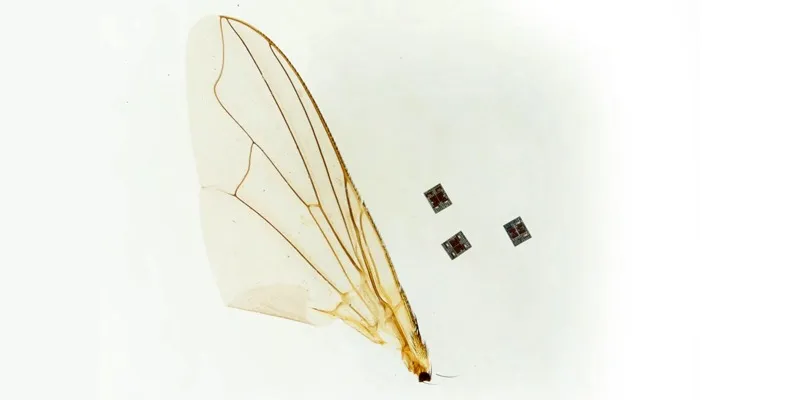
In a groundbreaking leap towards the future of technology, scientists have developed a remarkable microrobot that is pushing the boundaries of what we thought possible in the realm of robotics.
Created by researchers from the University of Pennsylvania and the University of Michigan, this sub-millimeter-sized robot is small enough to fit on a grain of salt but packed with the ability to sense, think, and act.
This breakthrough could one day pave the way for microscopic machines performing complex medical tasks within the human body, potentially revolutionizing treatments and surgery.
Scientists have made a monumental advancement in microrobotics by developing an astonishingly tiny robot, equipped with a computer, motor, and sensors.
While still in the experimental phase, the technology promises future applications, such as tissue repair and precision treatments inside the human body. “This is the first tiny robot capable of sensing, thinking, and acting,” said Marc Miskin, assistant professor at UPenn.
The robot uses solar cells to power its systems and can swim using electrodes to create a flow in surrounding water. Despite its small size, it is capable of detecting environmental changes, such as temperature shifts.
Currently, microrobots are controlled externally, limiting their functionality. However, by working at the micron scale, these new robots interact with the building blocks of biology. “Every living organism is essentially a complex of 100-micron robots,” Miskin explained.
The next step for researchers is enabling microrobots to communicate with each other, creating an interconnected network of autonomous robots. Coauthor David Blaauw predicts, “In 10 years, we could see real-world uses for robots like this.”