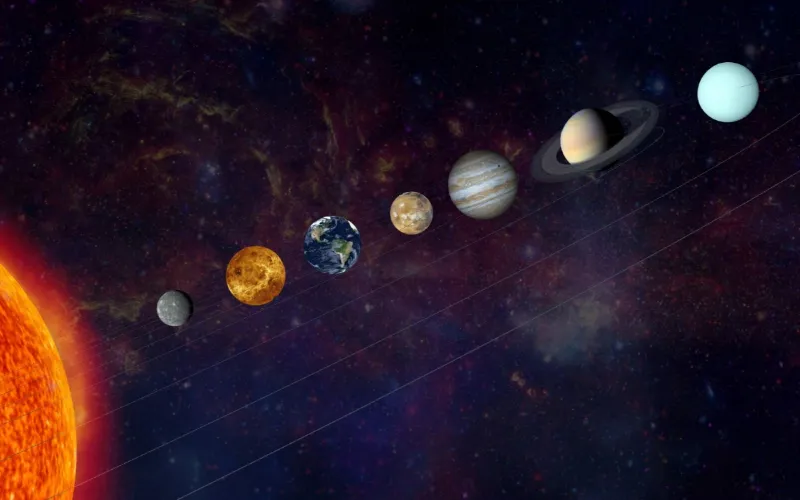
Earth’s climate has alternated between ice ages and warmer periods for millions of years, primarily due to subtle changes in its orbit and axial tilt. These variations known as Milankovitch cycles, occur because Earth does not orbit the Sun in isolation.
Other planets constantly exert gravitational forces on Earth, gradually altering its orbital path, axial tilt and the orientation of its poles.
Mars’ Surprising Role
Astronomers have long known that Jupiter and Venus play significant roles in Earth’s climate cycles.
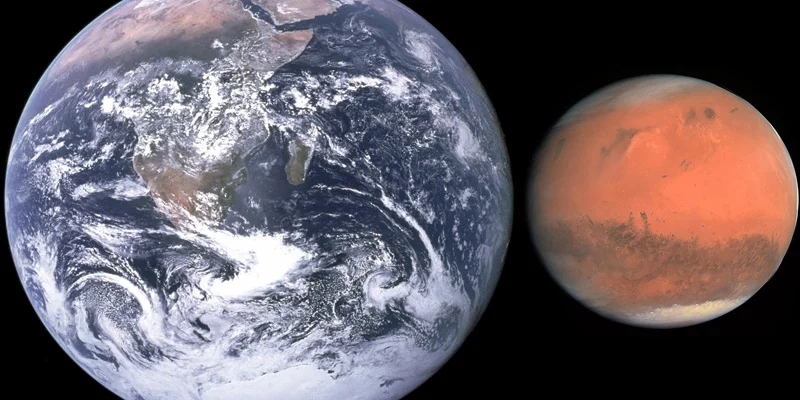
However, a recent detailed study shows that Mars, although smaller than the gas giants, also exerts a surprisingly strong influence on Earth’s climate rhythms.
Led by Stephen Kane, researchers ran computer simulations varying Mars’ mass from zero to ten times its current value to observe how these changes affected Earth’s orbit over millions of years.
The results highlight Mars as a key player in determining Earth’s seasonal patterns.
Key Climate Cycles and Mars’ Influence
Across all simulations, the most stable feature was the 405,000 year eccentricity cycle, driven by Venus and Jupiter. This cycle provides a consistent baseline for Earth’s climate variations, regardless of Mars’ mass.
However, shorter 100,000-year cycles, which pace ice age transitions are heavily influenced by Mars. As Mars’ mass increases in the simulations, these cycles become longer and more powerful. Strikingly, when Mars’ mass approaches zero, a crucial climate pattern disappears entirely.
The 2.4 million-year “grand cycle” responsible for long-term climate fluctuations, exists only because Mars has enough mass to create the necessary gravitational resonance. This cycle affects the amount of sunlight Earth receives over millions of years.
Earth’s axial tilt or obliquity is also influenced by Mars’ gravity. The 41,000-year obliquity cycle, visible in geological records, lengthens as Mars’ mass increases. If Mars were ten times heavier, this cycle would shift to 45,000–55,000 years, significantly altering the growth and retreat patterns of ice sheets.
Implications for Habitability of Earth-like Worlds
This discovery also helps scientists understand the role of other planets in shaping the climate of Earth-like worlds. A terrestrial planet with a suitably massive neighboring planet in the right orbital configuration may experience climate variations that prevent extreme freezing or create more favorable seasons for life.
The research demonstrates that Earth’s Milankovitch cycles are not solely a product of Earth and the Sun, they are shaped by the entire planetary neighborhood with Mars playing an unexpectedly important supporting role.