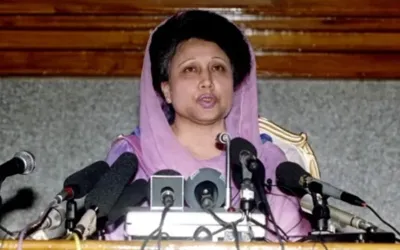
Former Bangladeshi prime minister Khaleda Zia, a towering figure in the country’s politics and a longtime rival of Sheikh Hasina, has died at the age of 80, her party announced on Tuesday.
The Bangladesh Nationalist Party (BNP) said Zia passed away at around 6am shortly after the Fajr prayer. She had been suffering from multiple health complications and was hospitalised in her final weeks.
Zia made history as Bangladesh’s first woman prime minister and dominated national politics for decades alongside Hasina, a rivalry that shaped the country’s political landscape for a generation.
Earlier this year, in January 2025, Bangladesh’s Supreme Court acquitted Zia in the last remaining corruption case against her, clearing the way for her potential return to electoral politics. The ruling came after years of legal battles that Zia and her supporters insisted were politically motivated. She returned to Bangladesh in May after receiving medical treatment in the United Kingdom.
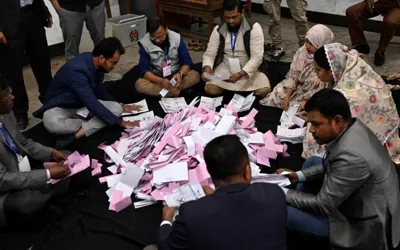
Despite prolonged illness and years of imprisonment, Zia had pledged in November to campaign in elections scheduled for February 2026 — the first national vote since a mass uprising toppled Sheikh Hasina’s government last year. Her BNP was widely regarded as a leading contender.
However, her health deteriorated rapidly after she was hospitalised in late November. Interim leader Muhammad Yunus urged citizens to pray for her recovery, describing Zia as “a source of utmost inspiration for the nation.”
Bangladesh’s early post-independence years were turbulent, marked by coups and assassinations following the 1971 war with Pakistan. Zia’s political career was closely tied to that history. Her husband, Ziaur Rahman, seized power in 1977 as army chief, later founding the BNP before being assassinated in a military coup in 1981.
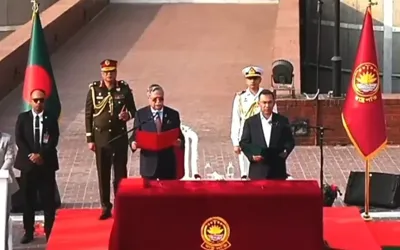
Khaleda Zia emerged as a central figure in opposition to military rule and played a key role in the mass movement that led to the downfall of military dictator HM Ershad in 1990. She first became prime minister in 1991, defeating Sheikh Hasina, the daughter of Bangladesh’s founding leader Sheikh Mujibur Rahman.
Her tenure was not without controversy. In early 1996, her party won a landslide election boycotted by major opposition parties, prompting protests and leading to the government’s collapse after just 12 days. A caretaker administration oversaw fresh elections later that year.
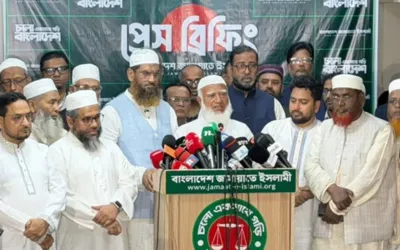
Zia returned to power in 2001, forming a coalition that included the Islamist party Jamaat-e-Islami. Her government pursued market-friendly economic policies that reassured business leaders, though critics accused her of tolerating extremism and straining relations with India. New Delhi alleged that insurgents used Bangladeshi territory during her 2001–06 term, claims her party denied.
In later years, Zia was sentenced to lengthy prison terms in corruption cases involving alleged misuse of funds from a charity named after her late husband. While her party called the charges an attempt to sideline the opposition, the Hasina government maintained that the judiciary acted independently. Hasina faced widespread criticism for Zia’s imprisonment, both domestically and internationally.
Khaleda Zia’s death marks the end of an era in Bangladeshi politics, closing a chapter defined by intense rivalry, political upheaval, and the country’s long struggle between authoritarianism and democracy.