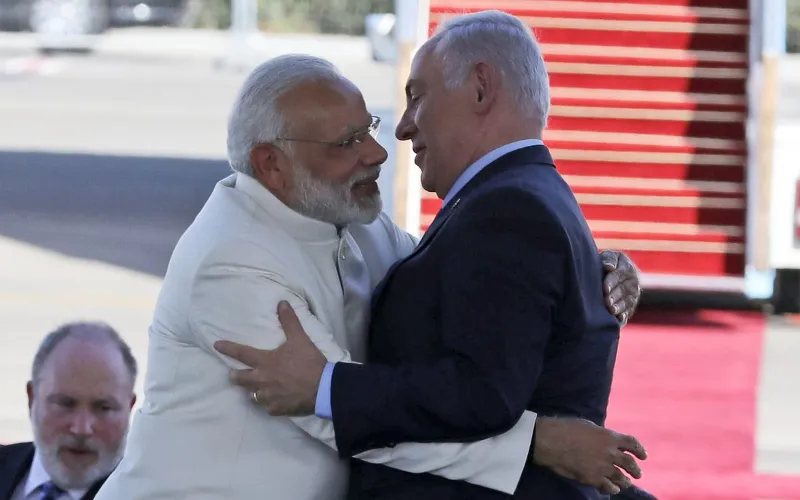
India and Israel have forged a robust partnership in defense, technology, agriculture, intelligence, and water management. This relationship evolved gradually from ideological opposition to New Delhi’s non-aligned stance and support for Palestine, toward open collaboration starting in the 1990s.
Early Opposition (1938–1949)
India’s founding leaders approached the idea of a Jewish state in Palestine with caution, reflecting concern over the implications for the Arab population and the broader principles of non-violence. In 1938, Mahatma Gandhi explicitly opposed the creation of a Jewish state, arguing that it would be detrimental to the Arabs living there and would contradict the ideals of non-violent coexistence that he championed.
By 1947, India’s position at the international level was consistent with this cautious stance. During the United Nations General Assembly discussions on the Partition Plan for Palestine, India voted against the proposal, signaling its concern for the potential displacement and conflict that partition could create.
In 1949, India continued to prioritize solidarity with Arab nations when it opposed the admission of Israel to the United Nations. This stance reflected a broader foreign policy approach that emphasized support for decolonization and the rights of Palestinians in the emerging post-war order.
Although India recognized Israel de jure in 1950, it refrained from establishing full diplomatic relations immediately. This delay allowed India to maintain its public support for the Palestinian cause while gradually navigating the complexities of Middle Eastern politics and its own strategic interests.
Covert Security Cooperation (1960s–1980s)
Full Diplomatic Engagement (1992 Onward)
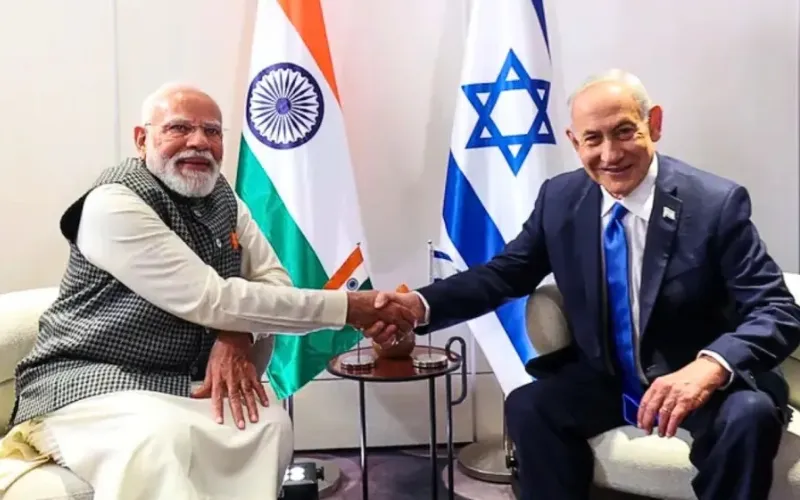
Recent Developments and “Strategic Partnership”
In 2023, during Modi’s visit, leaders elevated ties to a comprehensive partnership, focusing on AI, quantum tech, semiconductors, and critical minerals. Netanyahu visited India in 2024. Cooperation includes agricultural tech (drip irrigation boosting Indian yields) and counter-terrorism intelligence sharing.
Controversies and Criticisms
The partnership draws scrutiny over the Israel-Hamas war (post-Oct. 7, 2023). India abstained from some UN resolutions criticizing Israel but urged restraint and a two-state solution. Reports indicate India exported Hermes 900 drones to Israel (via third parties), though official denials exist. Israel has voiced support for India’s Kashmir stance, calling it a bilateral issue.
Human rights groups, including Amnesty International and Human Rights Watch, have noted parallels in security tactics in Kashmir (e.g., pellet guns, surveillance), some sourced from Israel. India rejects “occupation” labels for Kashmir, citing its status as an integral territory post-2019 reorganization. Critics argue deepening ties risk alienating India’s Muslim population and Arab partners.
This evolution reflects India’s shift from non-alignment to multi-alignment, prioritizing security and tech amid regional threats. For primary sources, see India’s Ministry of External Affairs or Israel’s Foreign Ministry archives.