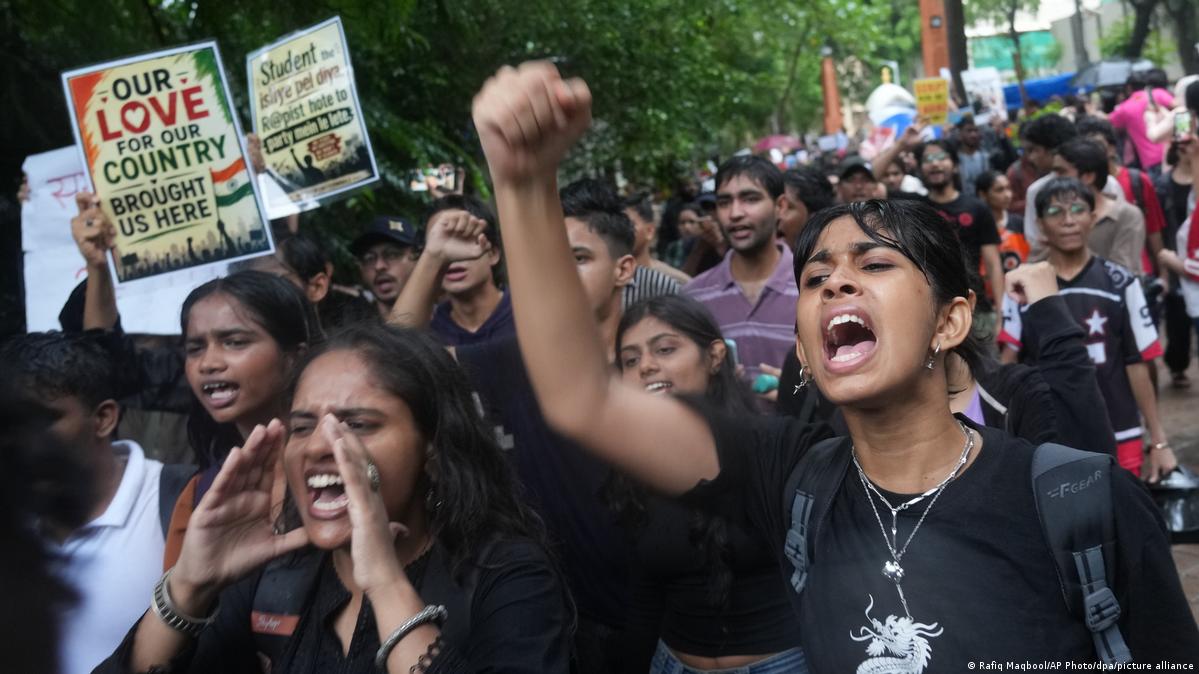
NEW DELHI: What began as a satirical online joke just months ago has exploded into one of India’s most visible youth-led uprisings, with tens of thousands of Gen Z protesters flooding the streets of Delhi and other major cities to demand the resignation of the country’s education minister.
The movement, dubbed the “Cockroach Janta Party” (CJP), has rapidly evolved from a meme-driven campaign into a formidable force, tapping into deep-seated frustrations over unemployment, government corruption, and the crumbling integrity of the nation’s examination system.
The protests, which ignited in June over mismanagement of medical entrance tests, have since swelled into a broader referendum on whether the state can still guarantee fairness for young Indians navigating a precarious economy.
A Protest Unlike Any Other
What sets the CJP apart from the major demonstrations that have challenged Prime Minister Narendra Modi’s government over the past decade, such as those over citizenship laws or farm policies, is its lack of ideological or communal roots. This is not a battle fought along religious or political party lines.
Instead, it strikes at the heart of the Indian dream: the exam system, viewed by millions as the primary escalator to social mobility.
Many of the demonstrators are not traditional opponents of the ruling Bharatiya Janata Party (BJP); they are aspirational students and their parents who feel betrayed by a system they once trusted.
Analysts suggest the BJP cannot easily deploy the counter-narratives that helped it weather previous protests, because this grievance is about governance, not ideology.
From Memes to the Streets
The movement’s name is a direct act of defiance, born after the Supreme Court chief justice reportedly compared unemployed youth to cockroaches. That insult was reclaimed as a badge of honor.
On July 20, the CJP called for a peaceful march to parliament, but the day descended into chaos. Scores were injured, including police officers, and a young woman protester remains in critical condition.
Protesters arrived not only with rage over paper leaks but with posters and slogans that spoke to a much deeper, generational despair. “They came because they wanted a space to express the deep frustration they have been carrying for some time,” one observer noted.
Government Steps In, But Is It Enough?
Initially, the ruling BJP left the response to junior ministers and spokespersons. But as the movement swelled, the party’s top brass stepped in. On Wednesday, Defence Minister Rajnath Singh accused the opposition of using students “as a political tool,” while insisting the government was committed to addressing their concerns through parliament.
Prime Minister Narendra Modi made his first public remarks on the crisis on Thursday, taking to X (formerly Twitter) to declare: “Nothing is more important than the welfare and future of our youth.”
He announced the creation of fast-track courts to ensure “swift and stringent punishment” for those involved in paper leaks, vowing that those who harm the future of India’s youth “will not be spared.”
Whether these assurances will defuse the anger remains highly uncertain, as the movement has already tapped into broader anxieties over a slowing economy, scarce jobs, and a deepening sense that the future offers diminishing returns.
Police Crackdown and Internet Shutdowns Draw Condemnation
The protests have also triggered a harsh state response, raising alarms among human rights groups. Since June, demonstrators had been occupying Jantar Mantar, a historic 18th-century observatory turned protest site just kilometers from parliament.
The situation intensified on July 18 after Delhi police forcibly removed activist Sonam Wangchuk, who had been on a hunger strike, from the site and admitted him to a hospital.
On July 20, telecommunication providers reportedly received orders to shut down mobile internet services across parts of central Delhi.
Protesters described terrifying scenes of chaos, with one telling reporters he lost his friends in a stampede-like situation and was beaten by police. He could not locate his companions, he said, “because they had shut down mobile internet and jammed mobile services, so no calls were going through.”
Calls for Accountability
Human Rights Watch has condemned the government’s response, noting that Indian authorities have a history of using internet shutdowns to restrict access to information and conceal security force abuses.
“India’s youth wanted to march peacefully to parliament to seek accountability from their elected leaders,” said Meenakshi Ganguly, deputy Asia director at HRW. “Instead, the police met them with batons, tear gas, and internet shutdowns.”
The right to peaceful assembly is protected under international law, which India has ratified. The UN Human Rights Council passed a resolution in 2016 unequivocally condemning internet shutdowns and calling on states to cease such measures.
Furthermore, UN guidelines stipulate that law enforcement should only use force when strictly necessary and proportionally, and that tear gas should not be used to disperse nonviolent demonstrations.
As the government attempts to regain control, the question remains: for a generation that feels increasingly invisible, will reform come fast enough to restore faith in the system, or will the cockroaches continue to scatter into the streets?