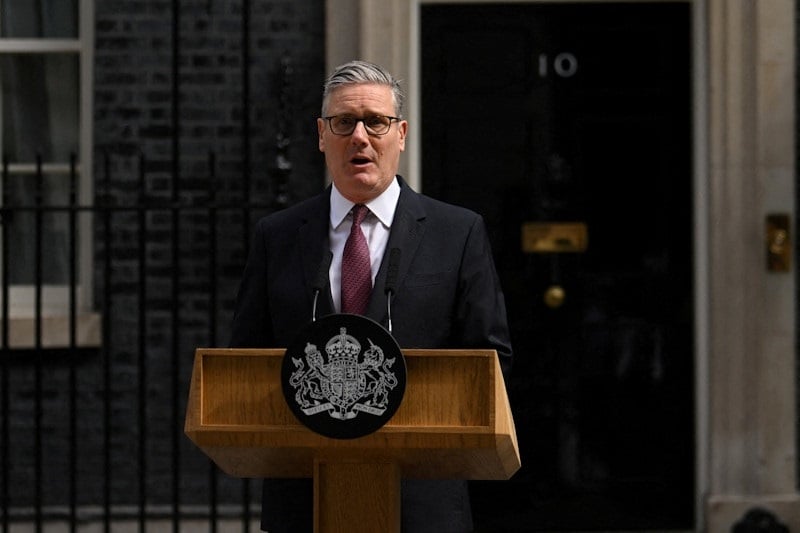
LONDON: Prime Minister Keir Starmer announced Monday he will resign as leader of the Labour Party, a stunning reversal less than two years after he won a landslide election victory that he had promised would end Britain’s era of political turbulence.
Starmer said he will remain in office as prime minister until a new Labour leader is chosen. His departure sets the stage for Britain’s seventh prime minister in a decade, underscoring the persistent instability that has defined Westminster politics since the 2016 Brexit referendum.
The threat to Starmer’s leadership had been building for months, but intensified sharply after former cabinet minister Andy Burnham decisively won a parliamentary by-election, returning to the House of Commons and fueling speculation about a leadership challenge.
Fighting back tears, his voice breaking as he closed his address, Starmer cast his decision as one of duty.
“I have heard the answer of my parliamentary party to that question, and I accept that answer with good grace,” Starmer said, referring to internal Labour deliberations. “Every decision I have taken has been about putting the country I love first. That is why I will resign as leader of the Labour Party.”
In his final words from the lectern, Starmer said that after leaving “the biggest job in British politics,” he would turn to “the most important job” being the best husband to his “fantastic wife,” Victoria, and the best father to his “beautiful children.”
Starmer said he had spoken Monday with King Charles III and pledged to ensure an orderly transfer of power. He vowed to give his successor his full support.
“I will do everything I can to see a smooth transition,” he said.
The prime minister’s resignation comes just 22 months after he led Labour to a historic general election victory, crushing the Conservative Party after 14 years in opposition. At the time, Starmer framed his win as a mandate for competence and stability after the scandal-plagued premierships of Boris Johnson, Liz Truss and Rishi Sunak.
Now, Labour faces an accelerated leadership contest that will determine who will steer the party, and the country, through a period of economic stagnation, persistent public-sector strikes and growing discontent over the government’s handling of immigration and health care.
Burnham, the mayor of Greater Manchester whose decisive by-election win in the constituency of Leigh revived his Westminster career, is widely seen as a leading contender. Other potential candidates include Deputy Prime Minister Angela Rayner, Chancellor Rachel Reeves and Foreign Secretary David Lammy.
The Labour Party’s national executive committee is expected to meet in the coming days to set a timeline for the leadership race. Under party rules, candidates must secure nominations from at least 20% of Labour MPs to make the ballot.
Starmer, 62, a former director of public prosecutions, entered politics in 2015 and rose to the Labour leadership in 2020 on a pledge to unite a party torn between its left wing and centrist factions.
His tenure was marked by early successes, including a decisive Brexit renegotiation stance and a rebound in Labour’s poll numbers, but critics accused him of abandoning key pledges, including sweeping nationalization and free university tuition.
No date has been set for Starmer’s final departure from Downing Street, but party officials said the leadership contest is expected to conclude within the next six to eight weeks.