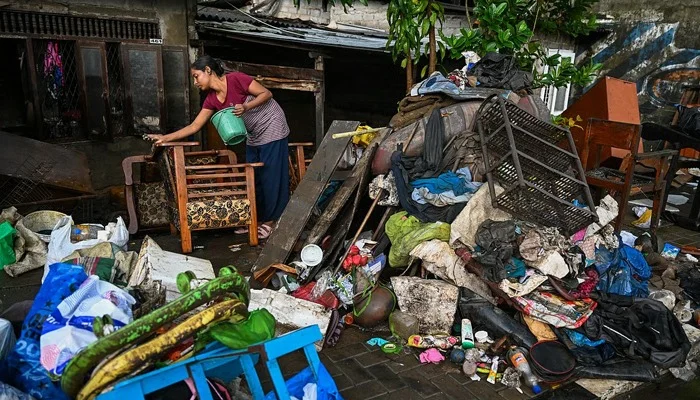
Sri Lankan authorities issued urgent landslide warnings on Sunday amid ongoing heavy rains, as the death toll from Cyclone Ditwah has surged to 618. The cyclone, the most severe to hit the island this century, caused widespread devastation last week, affecting more than two million people—approximately 10% of the nation’s population.
The Disaster Management Centre (DMC) reported that monsoon storms are intensifying, bringing more rain and destabilizing hillsides across critical regions, including the central mountainous areas and north-western midlands. To reach isolated communities cut off by landslides, helicopters and planes are actively engaged in relief efforts.
In a significant development, the Sri Lanka Air Force received a planeload of aid from Myanmar on Sunday, marking the latest foreign assistance as the country grapples with the aftermath of the disaster.
The government confirmed the tragic loss of 618 lives, with 464 from the central tea-growing region. Currently, 209 individuals remain unaccounted for. The number of people residing in government-run refugee camps has decreased from a peak of 225,000 to around 100,000 as floodwaters recede.
Damage to infrastructure has been extensive, with over 75,000 homes affected—nearly 5,000 of which have been completely destroyed. In response, the government announced a sizable compensation package aimed at rebuilding homes and revitalizing businesses devastated by the cyclone. Estimates suggest that recovery and reconstruction could cost up to $7 billion.
The International Monetary Fund (IMF) is considering Sri Lanka’s request for an additional $200 million in aid, supplementing the $347 million tranche scheduled for release later this month. This is part of a four-year, $2.9 billion bailout agreement reached in 2023.
President Anura Kumara Dissanayake addressed parliament on Friday, acknowledging the country’s economic recovery but emphasizing its vulnerability to shocks. Survivors of the cyclone will be eligible for compensation of up to LKR10 million (approximately $33,000) to purchase land and rebuild homes in safer areas. An additional LKR1 million is designated for each individual killed or permanently disabled.
While the government has yet to specify the total cost of the relief package, concerns remain over Sri Lanka’s recent economic turbulence. The central bank has instructed commercial lenders—both state-owned and private to reschedule loan repayments to ease financial strains for affected citizens.
As Sri Lanka continues its recovery, the focus remains on providing relief, rebuilding communities, and stabilizing the economy amidst ongoing challenges.