For the first time in modern political history, America’s largest political bloc is neither Democratic nor Republican.
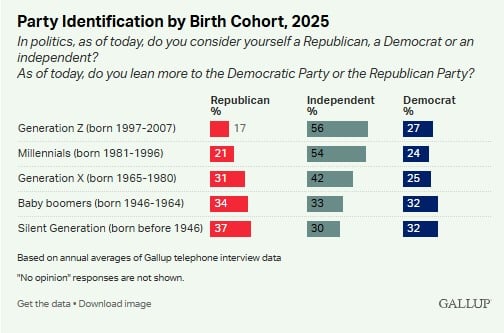
A Gallup poll released this year shows 45% of U.S. adults now identify as political independents, the highest share ever recorded. By comparison, just 27% identify as Democrats and 27% as Republicans, leaving the two major parties with a combined hold on only 54% of the electorate. Two decades ago, that number hovered closer to two-thirds.
This is not a momentary fluctuation. It is a structural shift.
Gallup has tracked party identification consistently since 1988, and while independents have often been the largest group, their share has surged over the past 15 years regularly exceeding 40% since 2011. The 2025 findings, based on interviews with more than 13,000 Americans conducted throughout the year, mark a decisive break from the political norms that defined the late 20th and early 21st centuries.
New High of 45% in U.S. Identify as Political Independents
Independents are no longer a swing vote. They are the majority.
A Slow Exodus Becomes a Rejection
The collapse of party loyalty did not happen overnight. It has been building steadily, driven by frustration that crosses ideological lines.
Voters cite Washington gridlock, broken promises, ballooning national debt, unresolved border security, and a political culture dominated by performative outrage rather than results. What once felt like dissatisfaction has hardened into something deeper: a rejection of the political establishment itself.
For generations, political parties served as the organizing engine of American democracy. They defined policy debates, selected candidates, mobilized voters, and offered ideological coherence. Today, nearly half the country refuses to affiliate with either party, signaling a loss of trust in the institutions that once structured political life.
Automatic partisan loyalty long the backbone of campaign strategy is eroding. Party platforms carry less weight with voters who increasingly view both brands with skepticism.
Politically Homeless America
The independent surge reflects a broad sense of political homelessness.
Many voters who value fiscal restraint, limited government, and institutional stability feel unrepresented. Others are exhausted by endless culture wars that dominate headlines while tangible progress remains elusive. Across the spectrum, Americans report the same frustration: politics feels more about winning than governing.
This disillusionment is reshaping the electoral map. It opens space for outsider candidates, third-party movements, and unconventional coalitions. It also injects uncertainty into every election. What was once a narrow slice of persuadable voters has become the dominant force in American politics.
The End of Predictability
For campaign strategists heading into the 2026 midterms, the implications are profound.
Mobilizing the base is no longer sufficient. Success now requires persuading a skeptical, brand-averse electorate that values competence and outcomes over ideology. Messaging is likely to grow more pragmatic, less doctrinaire. Candidates who can credibly distance themselves from partisan dysfunction may find a powerful advantage.
But the shift carries risks as well. America’s election infrastructure from primaries to campaign finance laws—was designed around a two-party system. When most voters reject that framework, legitimacy comes under strain. Volatile elections, surprise outcomes, and shifting alliances may become the norm rather than the exception.
Traditional polling may struggle to keep pace. Old campaign playbooks will require reinvention.
A System at a Crossroads
Independent voters now wield unprecedented influence. Politicians can no longer assume loyalty; they must persuade. That alone represents a fundamental change in how power is contested in the United States.
For Democrats and Republicans alike, the warning is unmistakable: your coalitions are shrinking. Survival will depend on broader appeal, internal reform, and a willingness to listen to voters who no longer trust political institutions by default.
The two-party system is not dead. But its dominance is fading.
What replaces it whether a revitalized center, stronger third parties, or a more fragmented political order remains uncertain. And that uncertainty may define American politics for years to come.