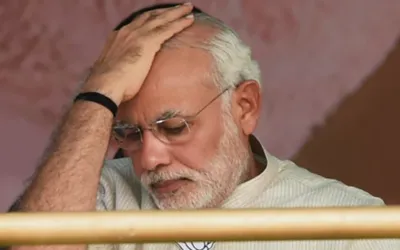
The internationally respected publication The Wall Street Journal has issued a strong critique of Indian Prime Minister Narendra Modi and the BJP government, highlighting the impact of its Hindutva policies and raising serious questions about India’s secular identity.
According to the report, under Modi’s leadership, India has increasingly shifted from being a full-fledged democracy to a majority-focused state, where not only Muslims but also Christian minorities face serious challenges.
The report notes a sharp rise in violence against religious minorities since 2014. Muslims experience discrimination in housing, employment, education, and voting rights, while the Christian community despite representing just 2.3% of the population has also been targeted by organized Hindutva-related attacks.
The Wall Street Journal highlights that by November 2025, 706 anti-Christian incidents were recorded. Data from the United Christian Forum shows that attacks have surged from 139 cases in 2014 to 834 in 2024. Incidents include assaults on churches, attacks during worship, and the destruction of Christmas symbols, which have increasingly become routine.
The report identifies Christmas 2025 as a national flashpoint for religious extremism, citing cases across multiple states where mobs chanted hate slogans, stormed churches, and destroyed religious symbols, without clear condemnation from the Modi government. The Wall Street Journal points out that while Modi visited a church, the lack of nationwide denouncement of these attacks sends a silent signal of approval to extremist groups.
The report also criticizes anti-conversion laws, police inaction, and state-level policies for effectively enabling violence against minorities. Specific examples include orders to keep schools open on Christmas in Uttar Pradesh, attacks on churches in Madhya Pradesh, and destruction of Christmas decorations in Chhattisgarh, all reflecting this disturbing trend.
India’s international reputation has also been affected. The US Commission on International Religious Freedom recommended designating India as a “Country of Particular Concern,” and political analysts suggest that government silence has emboldened extremists.
The report concludes that India’s claim to secularism has been exposed as superficial, and fear has increasingly become a defining experience for minorities.
In contrast, Pakistan highlighted religious harmony, with various religious and political leaders expressing solidarity with the Christian community during Christmas. Observers noted that India’s politics of hate risk isolating it diplomatically.
The Wall Street Journal’s report presents the reality of India under Hindutva, showing a side of the country that can no longer be ignored by the international community.