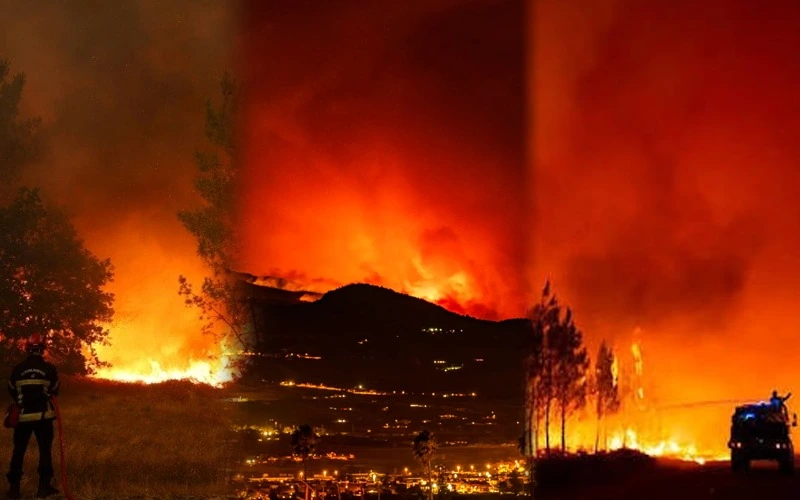
LE PORGE: Thousands of people were forced to evacuate on Friday as deadly wildfires swept across France, Italy and Spain, with scorching temperatures and strong winds driving the fast-moving blazes across southern Europe.
Authorities said at least three firefighters have been killed, while thousands of emergency personnel remain deployed as multiple fires continue to burn across the region.
France has also requested emergency assistance from the European Union as officials warned that extreme heat, dry conditions and strong winds continue to fuel the rapidly spreading fires.
France activated the European Union Civil Protection Mechanism after wildfires spread across the country’s southwest and southeast.
President Emmanuel Macron described the situation as “very intense”, while EU Crisis Management Commissioner Hadja Lahbib confirmed that the bloc had deployed three water-bombing aircraft to assist French authorities.
Read More: Japan wildfires: Hundreds of firefighters in action
More than 20,000 people, most of them tourists staying in campsites and holiday accommodation around Bordeaux, have been evacuated since Wednesday after a major wildfire swept through a coastal pine forest.
Fire officials said the blaze had been contained on its northern flank but remained active further south, where firefighters continued protecting homes around Lège-Cap-Ferret.
In Le Porge, resident Patrick Martineau said authorities ordered residents to leave as flames moved dangerously close to homes.
The gendarmes came and knocked on every door. The fire was about 500 metres away. We grabbed some things and left,” he said.
Authorities believe the wildfire may have been caused by a brush-clearing machine, although the exact cause remains under investigation.
Meanwhile, dozens of additional fires in southeastern France have destroyed around 25 homes near the historic village of Cotignac.
In Italy, around 6,000 firefighters, forest guards and civil protection personnel continued battling dozens of wildfires across Sicily and Calabria.
Italy’s Interior Ministry confirmed that one firefighter died after falling ill while responding to a wildfire in Sicily.
Officials said more than 160 wildfires have been recorded in Calabria, while local authorities alleged that some fires were deliberately started by arsonists. Police have launched investigations into the incidents.
Italy’s Civil Protection Agency said the fires were being fuelled by exceptionally high temperatures and extremely dry soil.
Spain also remained on high alert after authorities declared a state of emergency in the Madrid region following widespread evacuations.
More than 10,000 residents have been forced to leave their homes in recent days, while emergency alerts were issued for people living in Aldea de Fresno, west of Madrid.
Firefighters managed to slow a wildfire near Toledo, allowing most evacuated residents to return home. However, a larger blaze in Guadalajara province continued to burn despite the efforts of hundreds of firefighters and military personnel.
Spain’s Civil Protection chief, Virginia Barcones, warned that soaring temperatures and strong winds continued to hamper firefighting efforts.
She said some wildfires had become so intense that emergency crews had “no chance” of stopping their advance under current weather conditions.
Southern Europe continues to experience an intense heatwave, with temperatures exceeding 40°C in several regions.
According to the European Forest Fire Information System (EFFIS), the total area burned across European Union member states this year is already the second largest on record.
A study published by the World Weather Attribution group concluded that climate change has intensified drought conditions across Europe, creating hotter and drier landscapes that allow wildfires to spread more rapidly.
Authorities across southern Europe remain on high alert as firefighters continue working to contain multiple wildfires. Officials warned that persistent heat, dry weather and strong winds could trigger further outbreaks in the coming days, with additional evacuations possible if conditions continue to deteriorate.