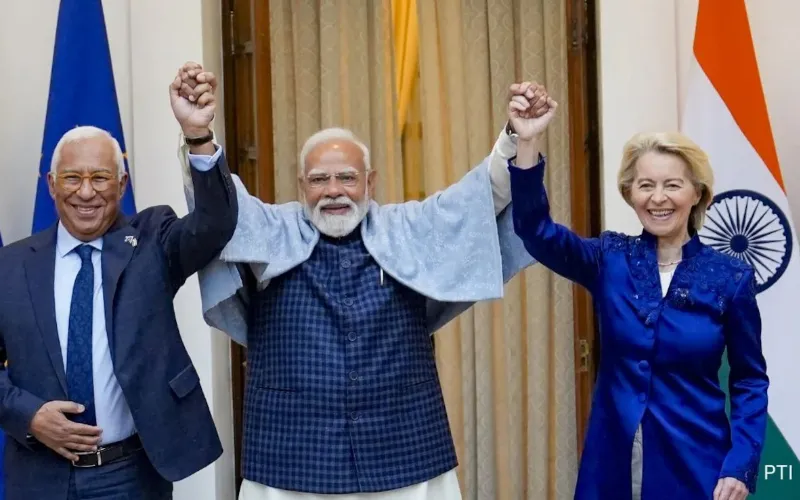
New Delhi: India and the European Union on Tuesday clinched a historic free trade agreement, capping nearly two decades of intermittent negotiations and marking a major shift in global trade alignments. European Commission President Ursula von der Leyen described the pact as the “mother of all trade deals” after talks with Indian Prime Minister Narendra Modi and European Council President Antonio Costa in New Delhi.
The agreement establishes a free trade zone encompassing nearly two billion people and around a quarter of global GDP, significantly strengthening economic, strategic and political ties between the two sides amid rising geopolitical uncertainty and trade fragmentation.
Calling the moment “historic,” von der Leyen said the deal would deliver mutual benefits and deepen cooperation across sectors. Indian Prime Minister Modi said the agreement would unlock new opportunities for India’s 1.4 billion people as well as millions across the EU, highlighting gains for Indian industries such as textiles, gems and jewellery, and leather goods.
Beyond trade, the summit focused on defence and security, climate action, critical technologies and reinforcing a rules-based global order. India and the EU also unveiled a new security and defence partnership and a broader strategic agenda, underscoring their intent to work more closely as both seek to reduce dependence on traditional partners such as the United States, China and Russia.
Under the agreement, tariffs on 96.6 percent of EU goods exports to India will be eliminated or reduced.
Duties on machinery, chemicals and pharmaceuticals will largely be scrapped, while car tariffs will gradually fall to 10 percent under a quota of 250,000 vehicles annually. Tariffs will also be eliminated on most aircraft and spacecraft exports.
Alcohol tariffs will be lowered to 20–30 percent on wine, 40 percent on spirits and 50 percent on beer, while duties on fruit juices and processed foods will be removed entirely. EU service providers will gain enhanced access to key Indian sectors including financial and maritime services.
EU officials estimate the deal will save European exporters up to €4 billion annually in duties and could double EU exports to India by 2032. Bilateral trade in goods already reached €120 billion in 2024, with services trade adding another €60 billion.
Formal signing of the agreement will take place after legal vetting, expected to take five to six months, with implementation likely within a year.
The breakthrough comes amid heightened trade tensions triggered by US tariffs and Chinese export controls, prompting both Brussels and New Delhi to diversify markets and supply chains. Negotiations, first launched in 2007, gained momentum after Russia’s invasion of Ukraine and renewed global trade uncertainty.
The India-EU pact follows a series of recent trade agreements by both sides, including EU deals with Mercosur, Indonesia and Mexico, and India’s agreements with the UK, New Zealand and Oman signaling an accelerating push toward economic realignment on both fronts.