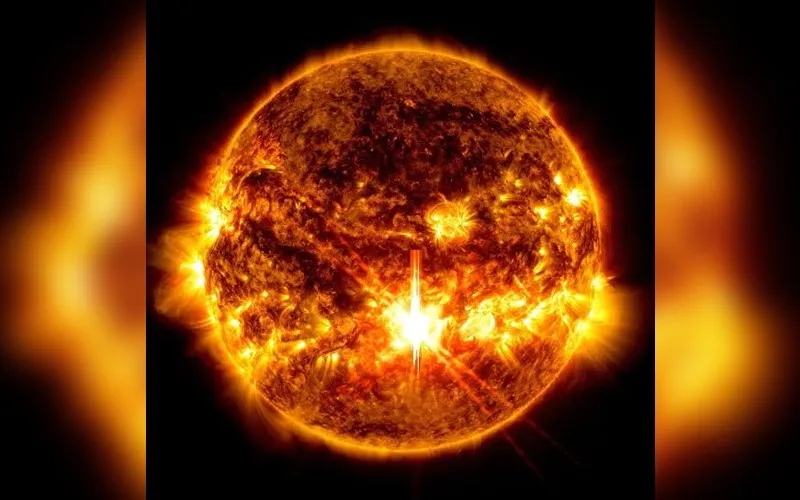
A series of intense solar eruptions is expected to increase geomagnetic activity over the July 4 holiday weekend, raising the possibility of visible northern lights across parts of the Northern Hemisphere, according to space weather experts.
The Sun has recently entered a highly active phase, producing 10 M-class solar flares within a 24-hour period, following a powerful X1.1-class flare on June 30. These eruptions have generated multiple coronal mass ejections (CMEs), large clouds of solar plasma and magnetic fields that are now traveling toward Earth.
Scientists are monitoring the incoming solar storms to determine how many will interact with Earth’s magnetic field and how strong the resulting geomagnetic disturbances may be.
Solar physicist Dr. Tamitha Skov described the unusual burst of activity as a “Machine-Gun Sun,” referring to the rapid sequence of powerful solar eruptions.
The U.S. National Oceanic and Atmospheric Administration (NOAA) National Oceanic and Atmospheric Administration Prediction Center has forecast moderate geomagnetic storm conditions, classified as G2, beginning July 3 and continuing through July 4.
Read More: G3 geomagnetic storm may bring Northern Lights to US
Geomagnetic storms occur when charged particles from the Sun interact with Earth’s magnetic field, releasing energy that can produce auroras, commonly known as the northern lights.
Dr. Skov said the intensity of the auroras will depend on the magnetic orientation of the incoming solar material. If conditions align favorably, the storms could produce brighter and more widespread auroral displays.
However, experts caution that space weather forecasts remain uncertain, and the exact strength and timing of the auroras can change as the solar material travels through space.
Skywatchers are advised to move away from city lights and look toward northern horizons during peak nighttime hours, typically between 10 p.m. and 2 a.m., for the best chance of viewing the phenomenon.
While summer conditions may reduce visibility due to shorter and brighter nights, modern smartphone cameras may still capture faint auroral colors, including greens, purples, and pinks.
Forecasts suggest geomagnetic activity will gradually weaken after the holiday weekend, but the coming days may still offer strong opportunities for aurora sightings in suitable locations.