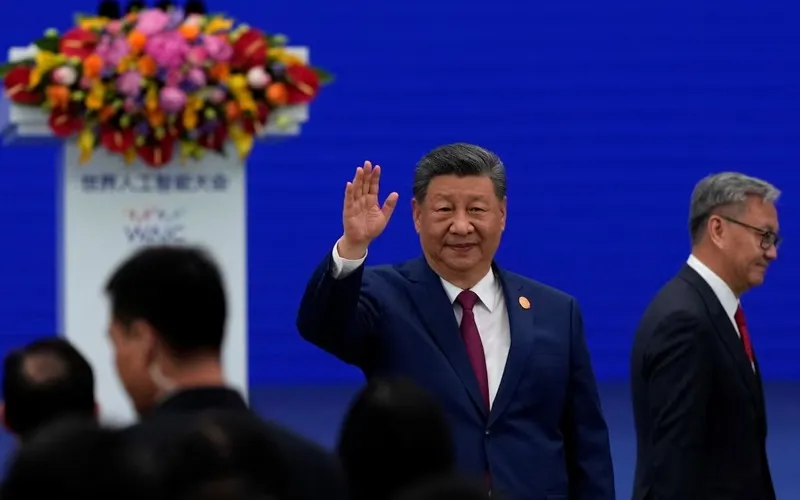
Shanghai: Chinese President Xi Jinping has called for greater international cooperation in artificial intelligence (AI), saying the rapidly developing technology should benefit all countries and not become an area dominated by a few nations.
Addressing the World Artificial Intelligence Conference in Shanghai on Friday, Xi presented China as a partner for developing countries seeking to expand their AI capabilities and encouraged nations to work together to address the opportunities and challenges created by artificial intelligence.
Xi said AI development should not be controlled by a single country but should become a platform for global cooperation and shared progress.
He announced that China would provide 5,000 AI training and seminar opportunities for developing countries and expand cooperation with various international groups, including the Association of Southeast Asian Nations (ASEAN), the League of Arab States and the African Union.
“China is willing to work with all parties to seize the opportunities and address the challenges of artificial intelligence development with a more open attitude, practical actions and a long-term vision,” Xi said, according to a translation of his remarks delivered in Mandarin.
Read More: Chinese President Xi Jinping to visit North Korea next week, state media says
Xi said the future of artificial intelligence should be based on international collaboration rather than competition between individual countries.
“AI development should not be a solo performance by one country, but a symphony of international cooperation,” Xi said, emphasising that nations should work together to shape the future of the technology.
His remarks came a day after 29 countries signed an agreement in Shanghai to establish the World Artificial Intelligence Cooperation Organization (WAICO), according to Chinese state media outlet Xinhua.
The organisation will be headquartered in Shanghai and aims to promote cooperation among countries in the field of artificial intelligence.
Xi also stressed the importance of managing risks associated with artificial intelligence, saying AI systems should remain secure, controllable and under human supervision.
He urged countries to strengthen risk awareness and ensure that AI development remains aligned with human interests.
Without naming any specific country, Xi warned against “overstretching the national security concept” in the field of AI or prioritising one nation’s security concerns over others.
His remarks came amid ongoing technology tensions between China and the United States, particularly over access to advanced chips and computing technologies.
The United States has introduced several export control measures aimed at limiting China’s access to advanced semiconductors and high-end computing technologies.
Restrictions began during former US President Donald Trump’s first administration, including the placement of Chinese technology company Huawei on the US Commerce Department’s Entity List in 2019.
The Biden administration later expanded these measures in 2022 by imposing additional controls on China’s ability to purchase advanced computing chips and manufacture high-end semiconductors, citing national security concerns.
US chipmaker Nvidia has also faced difficulties in maintaining its position in China’s artificial intelligence and data centre market due to export restrictions.
In its annual report, the company said it was unable to develop and deliver a competitive data centre product for China that could receive approval from both Beijing and Washington.
Nvidia said that by the end of fiscal year 2026, it had effectively been blocked from competing in China’s data centre computing market, allowing rival companies to strengthen their developer and customer networks globally.
The growing restrictions and competition highlight the broader technology rivalry between China and the United States, with artificial intelligence emerging as one of the key areas of global competition.