What if clothes could clean themselves, recover from damage, and grow stronger with the right care? Scientists in China are turning that idea into reality by developing a living textile made from fungal mycelium that can renew its surface and partially repair holes.
Developed by researchers at the Shenzhen Institutes of Advanced Technology, the innovative material is an engineered living material (ELM) that keeps dormant Cordyceps militaris mycelium inside its structure. The breakthrough research was published in the peer-reviewed journal Science Advances.
Unlike conventional fungal materials, which often lose their biological activity during processing, this new textile preserves the fungus in a dormant state, allowing it to be reactivated when needed.
Researchers found that after being dried at 45 degrees Celsius, the fungal material enters a low-metabolic state rather than becoming completely inactive.
The dormant mycelium can be restored by applying a nutrient solution made from potato water, which encourages the growth of new fungal filaments. These new structures help refresh the fabric’s surface and restore damaged areas.
For larger holes, scientists introduced fresh mycelium into the damaged sections and provided nutrients, allowing the fungus to grow across the gap and reconnect the material naturally without traditional stitching or adhesives.
The textile also has natural self-cleaning properties. Its fungal surface forms a water-resistant layer, causing dirt and water droplets to roll away more easily without leaving residue.
Researchers designed the fungal textile as a flexible platform that can gain additional features by combining it with other organisms.
By adding engineered yeast, the material can produce natural colors, including light blue, red, orange, and dark purple shades. Another fungal addition, Aspergillus niger, creates a melanin-rich layer that improves UV protection and antioxidant properties.
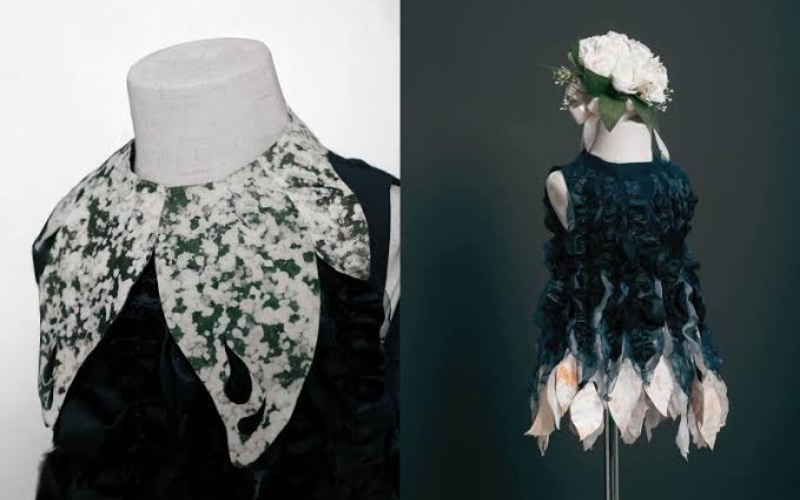
To showcase the technology, the research team created a prototype dress using different fungal textile sections, including self-cleaning and naturally colored areas.
Lead researcher Ke Li said the material’s unique qualities, including biological coloring, controlled repair, and biodegradability, could make it valuable for future products where appearance, sustainability, and limited product lifespan are important.
Although the innovation shows promising potential, researchers said the technology remains in its early stages. Improvements are still required in areas such as durability, moisture resistance, safety, and large-scale production before it can be introduced into everyday clothing or permanent structures.
The development reflects a growing shift toward bio-based materials, where scientists are exploring how living organisms can help create more sustainable solutions for the future of fashion and design.