China’s highest-rated television event, the CCTV Spring Festival Gala, took the spotlight on Monday, spotlighting Beijing’s ambitious industrial agenda and its drive to dominate the global humanoid robotics and advanced manufacturing sectors.
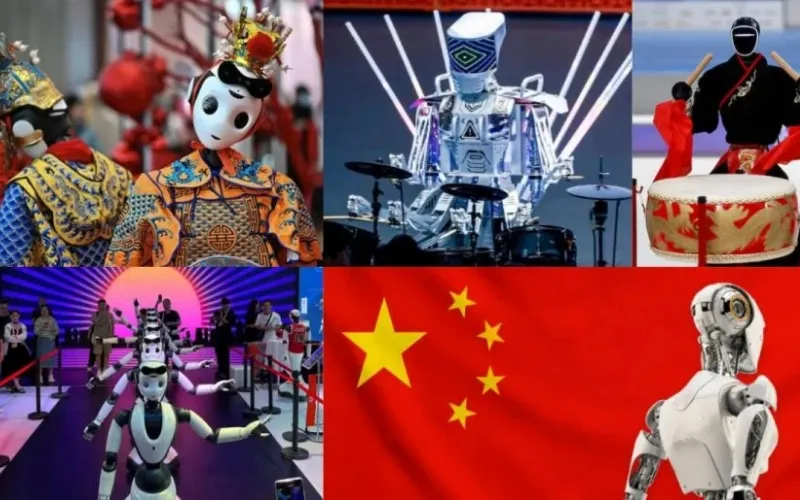
The gala, often likened to the Super Bowl of China, featured live demonstrations from four emerging humanoid robotics startups Unitree Robotics, Galbot, Noetix, and MagicLab.
The opening sketches stole the show with a high-octane martial arts sequence in which over a dozen Unitree robots executed synchronized sword, pole, and nunchuck routines alongside human child performers.
A particularly impressive segment emulated the “drunken boxing” style of traditional Chinese martial arts, highlighting sophisticated multi-robot coordination and fault recovery technology, enabling robots to regain balance and continue performing flawlessly after falls.
The gala also spotlighted Bytedance’s AI chatbot Doubao, while Noetix robots joined human actors in a comedic skit, and MagicLab robots performed a synchronized dance to the song “We Are Made in China.”
This celebration of humanoid robotics coincides with a pivotal moment for the industry, as companies like AgiBot and Unitree prepare for upcoming IPOs, and domestic AI startups unveil cutting-edge models during the nine-day Lunar New Year holiday.
Last year, 16 Unitree humanoids wowed audiences with synchronized handkerchief dances, earning a subsequent high-profile meeting with President Xi Jinping.
Over the past year, Xi has personally engaged with five robotics startup founders a level of attention comparable to his meetings with electric vehicle and semiconductor entrepreneurs granting the robotics sector unprecedented visibility.
The gala, which drew 79% of China’s live TV audience last year, has long served as a showcase for Beijing’s technological ambitions, from space programs to drones and robotics, according to Georg Stieler, Asia Managing Director at consultancy Stieler. “What sets this gala apart is the direct translation of industrial policy into prime-time spectacle,” he said. “Startups featured here often secure government contracts, investor attention, and broader market access.”
Stieler also noted the impressive advancement in robotic performance, pointing to Unitree’s AI-powered robot “brains”, which enable precise motor control with real-world applications in manufacturing.
Beijing-based tech analyst Poe Zhao added, “Humanoids package China’s core strengths AI, hardware supply chains, and manufacturing prowess into an instantly understandable form for both the public and policymakers. In a nascent market, visibility is as valuable as capital.”
China currently produces 90% of the world’s roughly 13,000 humanoid robots shipped last year, far ahead of U.S. rivals, including Tesla’s Optimus, according to research firm Omdia. Morgan Stanley projects that China’s humanoid robot output will more than double to 28,000 units this year.
Even Elon Musk has acknowledged the rising competition, naming Chinese companies as Tesla’s biggest challengers as it pivots toward embodied AI and humanoid robotics. “The world underestimates China, but they operate at an elite, next-level scale,” Musk remarked last month.