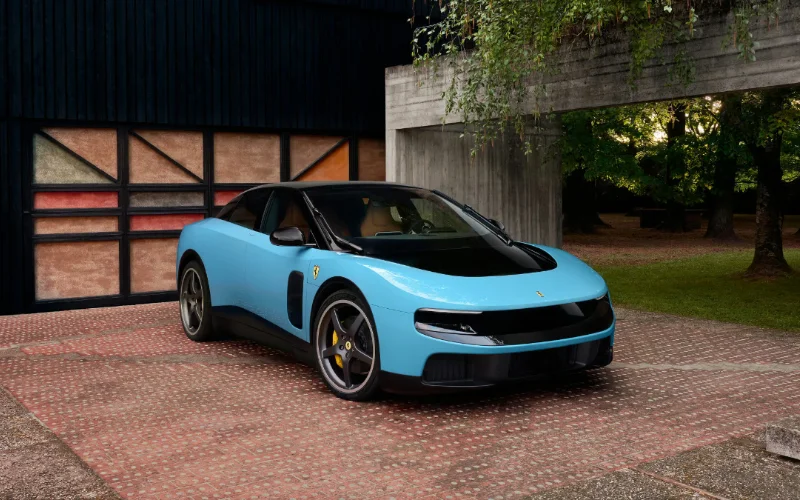
ROME: Luxury sports car maker Ferrari has unveiled its first fully electric vehicle, the “Luce,” marking a major shift for the brand as global automakers reassess their electric vehicle strategies amid weakening demand.
The company said the new model, whose name means “light” in Italian, comes at a time when several rivals are re-evaluating their EV plans due to slowing market demand.
The four-door “Luce” is being described as Ferrari’s first five-seater in its history. Its design reportedly involves collaboration with Jony Ive and his creative firm LoveFrom.
Unlike Ferrari’s traditional sports car styling, the Luce features a more spacious, glass-heavy design. Its interior combines leather, glass and anodized aluminum, while retaining physical buttons alongside digital controls instead of a fully touchscreen-based system.
Performance-wise, the vehicle includes four electric motors—one for each wheel producing more than 1,000 horsepower combined. The company says it can exceed speeds of 310 km/h and travel over 500 kilometers on a single charge.
Despite being fully electric, Ferrari has incorporated systems to simulate engine-like vibrations and driving feedback inside the cabin to preserve its traditional driving feel.
The luxury EV offers 600 liters of boot space and advanced technology features. It is priced at approximately 550,000 euros ($640,000).
Ferrari Chief Executive Officer Benedetto Vigna said the project represents five years of development work, with deliveries expected to begin in the final quarter of 2026.
More read, Hyundai recalls over 54,000 hybrid vehicles in US over fire risk
Earlier, Hyundai Motor Company is recalling more than 54,000 hybrid vehicles in the United States due to a potential fire risk caused by overheating components, federal regulators said Thursday.
The recall affects certain model year 2024 to 2026 Hyundai Elantra Hybrid vehicles, according to the National Highway Traffic Safety Administration.
NHTSA said the hybrid power control unit can overheat under high electrical loads, potentially causing affected vehicles to fail to start or enter a reduced-power mode.