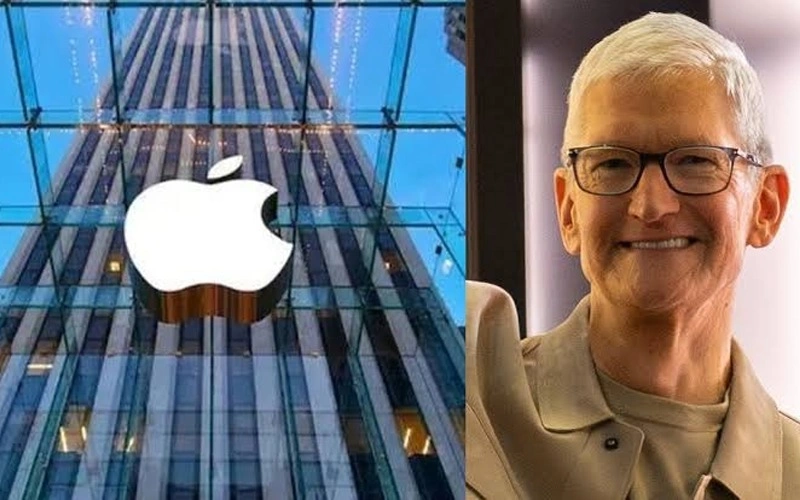
CUPERTINO: After 15 years at Apple’s helm, Tim Cook is handing the reins to John Ternus on Tuesday, opening a new chapter for the technology giant as it confronts the next wave of artificial intelligence and product innovation. Cook will remain at Apple as executive chairman.
Cook formally stepped down as CEO after leading Apple since 2011, when he succeeded co-founder Steve Jobs. Ternus, Apple’s senior vice president of Hardware Engineering, officially takes over as CEO on Sept. 1, marking Apple’s first CEO transition in 15 years.
The transition closes one of the most consequential leadership chapters in Apple’s history. Under Cook, the company grew from a roughly $350 billion enterprise into a technology powerhouse valued at more than $4 trillion, while expanding beyond its hardware business into services and other areas.
Cook’s final message
On his final day as CEO, Cook sent a message to Apple employees reflecting on his time at the company and expressing gratitude to the people who helped shape its growth.
“Sending lots of love to the Apple community on my last day as CEO,” Cook wrote in a post on X, formerly known as Twitter. “My title changes tomorrow, but the love I have for the Apple community never will.”
Cook said Apple’s achievements were ultimately the result of its people and emphasized that the accomplishments he valued most could not necessarily be measured in an annual report.
Read More: YouTube Music may get Apple’s sleek Liquid Glass look
He also expressed confidence in Ternus and said he was comfortable handing the company’s leadership to an executive he considers highly capable.
Although Cook is leaving the CEO position, he is not leaving Apple.
He will serve as executive chairman of the company’s board, allowing him to remain involved with Apple while Ternus takes responsibility for its day-to-day operations. Apple announced the leadership transition in April following a succession process approved unanimously by its board.
“As you know, I am not leaving Apple,” Cook wrote. “But I am stepping away from a role that I have loved deeply.”
Cook said he would miss leading the company and working alongside employees but added that he was at peace with the decision.
He also praised Ternus, describing him as “brilliant,” “wonderful” and capable of leading Apple into its next phase.
Who is John Ternus?
Ternus joined Apple in 2001 and has spent more than two decades working on the company’s hardware operations. He became senior vice president of Hardware Engineering in 2021 and has played a major role in the development of Apple’s hardware products.
His promotion puts a hardware-focused executive in charge at a time when Apple is under growing pressure to accelerate its artificial intelligence strategy.
Ternus inherits a company with an enormous global customer base, a powerful ecosystem and a vast services business, but also one facing intense competition from technology companies moving quickly in AI.
The challenges ahead
One of Ternus’ biggest challenges will be keeping Apple competitive in artificial intelligence.
Apple has faced criticism over delays in its AI development, particularly the rollout of a more advanced Siri. The company has increasingly relied on partnerships and outside technology as it works to strengthen its AI capabilities.
Apple also faces questions surrounding some of its newer products. Its Vision Pro mixed-reality headset has struggled to achieve the level of commercial success the company hoped for, while reports of layoffs and restructuring in the Vision Pro division have added to concerns about the platform’s future.
The company has also abandoned its long-running electric vehicle project, another example of the difficulty Apple has faced when expanding into entirely new product categories.
A different kind of Apple legacy
Cook’s tenure was markedly different from the era of Jobs. Rather than building Apple around a founder-driven product vision, Cook focused heavily on operations, supply chains, services and expanding the company’s global reach.
During his leadership, Apple diversified parts of its manufacturing network beyond China, increased production in countries including India and Vietnam and turned its enormous base of device users into a major source of recurring services revenue.
That strategy helped make Apple larger and more financially powerful, even as critics questioned whether the company had maintained the same pace of groundbreaking innovation associated with the Jobs era.
Now, Ternus inherits that legacy while facing a new technological race.
For Cook, the change marks the end of his time as Apple’s chief executive but not the end of his relationship with the company. For Ternus, it is the beginning of a new test: guiding Apple through an era in which artificial intelligence, new hardware and rapidly shifting technology expectations are reshaping the industry.