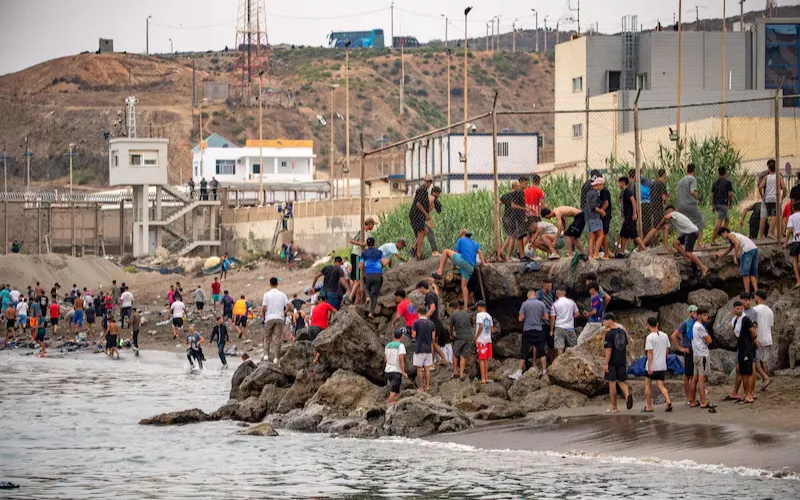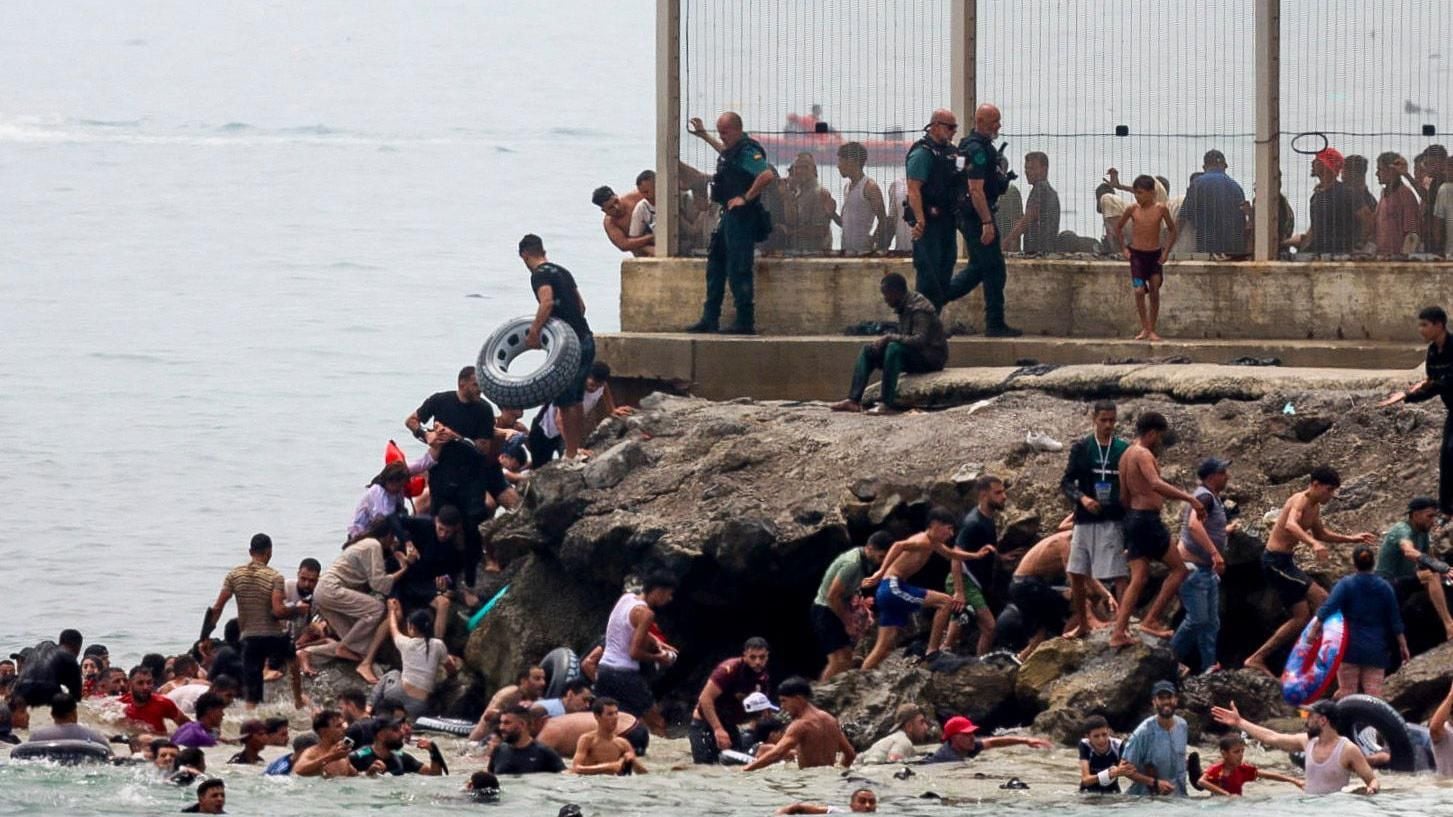
CEUTA: Thousands of migrants who stormed into Spain’s North African enclave of Ceuta earlier this week began returning to Morocco on Saturday, citing hunger, exhaustion, and hostility from locals as they abandoned dreams of reaching mainland Europe.
Many of those heading back told Reuters they had been lured by viral social media videos and messages from friends suggesting the heavily fortified border could be easily breached. But upon arrival, they found no viable path onward to continental Spain.
In Fnideq, the Moroccan town opposite Ceuta, streets that swelled with thousands on Thursday were nearly empty. Young men walked away from the frontier along the highway or waited for taxis, while shops remained shuttered for a third day, according to reports.
Returnees described scavenging for food and water as their soaked clothes dried on the streets. Some accused residents of El Principe, a predominantly Moroccan neighborhood in Ceuta, of attacking or driving them out. Spain’s Interior Ministry said two people sustained minor injuries in separate knife attacks, with one suspect arrested. No fatalities from stabbings have been recorded since Thursday, the ministry added.
On the Ceuta side, cafes reopened and customers returned as the city slowly normalized, though most shops remained closed. Police patrols were visibly increased. Residents said tensions persisted on the outskirts, and an aid worker at a migrant reception center said the facility was full, with thousands still believed to be in the enclave.
Spanish authorities reported that crossings had ceased overnight. On Saturday, police began installing a 500-meter (1,640-foot) floating barrier off the border to deter future attempts. The pneumatic barrier, built on the Tarajal breakwater, is designed to stand 30 to 70 centimeters above water and extend up to a meter below, with a channel for patrol vessels.
The surge, one of the largest at a European Union land border with Africa, saw an estimated 50,000 people enter Ceuta by land and sea from Thursday, according to Spanish figures. More than 48,000 had returned to Morocco within 48 hours.
Die spanische Exklave Ceuta wird derzeit überrannt: Bereits mehr als 1.500 Migranten, vorwiegend aus Marokko und Algerien, gelangten in kürzester Zeit in die EU. Ihr Ziel dürfte mutmaßlich Deutschland sein. Grenzen müssen jetzt geschlossen und Abweisungen rigoros durchgesetzt… pic.twitter.com/hW7RtKi2OE
— Alice Weidel (@Alice_Weidel) July 30, 2026
EU Calls Emergency Meeting
The crisis prompted alarm across the bloc, with 22 member states calling for coordinated action to protect external borders. Ireland, holding the rotating EU presidency, scheduled an emergency video conference of interior ministers for Tuesday.
Spanish Prime Minister Pedro Sanchez criticized Italy’s decision to suspend passport-free Schengen travel with Madrid for one month. “In the current international context, the EU cannot afford this kind of selfish, polarizing, and unlawful reaction,” Sanchez wrote in a letter to EU Commission and European Council presidents.
Death Toll Rises to 67
Officials confirmed at least 67 bodies have been recovered on the Spanish side, with migrants drowning or being crushed while attempting to scale breakwaters and border fences. Many were driven by economic hardship and fueled by social media rumors.
Interior Minister Fernando Grande-Marlaska blamed smuggling networks for exploiting vulnerable migrants and misinterpreting a Spanish Supreme Court ruling that prohibits summary returns of migrants intercepted at sea without a physical barrier. Speaking from Ceuta, he said order had been largely restored within 24 hours but cautioned the crisis was not over, adding that reinforced police and military deployments would remain as needed.
Grande-Marlaska also stressed Morocco remained a reliable partner, though he noted no intelligence indicated a mass entry was imminent.
The AUGC Civil Guard union requested at least 200 additional officers and warned that more measures were needed to prevent swimmers from circumventing the new barrier.
Madrid reiterated that migrants who entered Ceuta irregularly cannot travel onward to mainland Spain or elsewhere in the Schengen zone. Travelers leaving by sea or air face police identity checks, the Foreign Ministry said.
Spain, which has adopted a more open stance on migration than most of Europe, recently introduced a program to grant residency to more than 500,000 undocumented people. However, officials rejected suggestions that the regularization plan encouraged the rush, noting applicants must prove residence in Spain before Jan. 1, 2026, and have resided continuously for five months at the time of application.