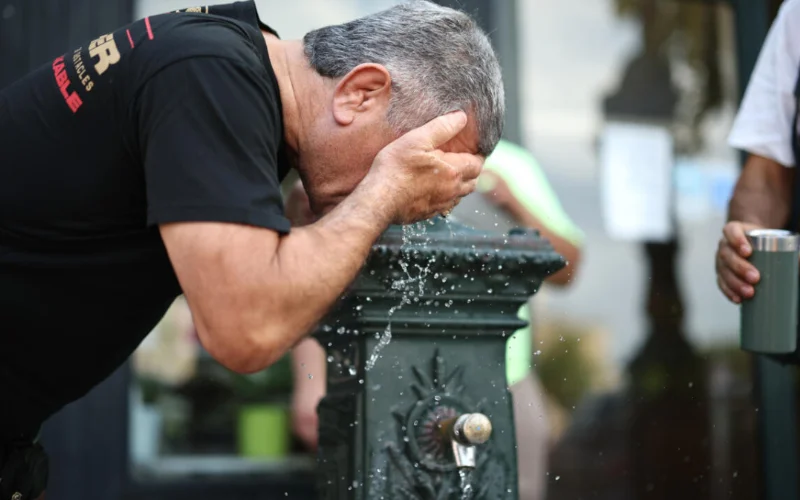
PARIS: A record-breaking heatwave gripped Western Europe on Wednesday, claiming dozens of lives, disrupting daily life, straining power supplies and causing heavy losses to agriculture across the region.
France, which recorded its hottest day since weather records began nearly 80 years ago, saw temperatures reach 44.3 degrees Celsius (111.7 degrees Fahrenheit) in the southwestern town of Pissos. Authorities worked to restore electricity to thousands of homes in Brittany following heat-related power outages.
At least 48 people in France died from drowning while seeking relief from the extreme temperatures, while two young children died after being left in a vehicle during the heatwave, officials said.
In Spain, where temperatures have exceeded 40 C since the weekend, two elderly people died from heatstroke. The country’s weather agency said Monday and Tuesday were the hottest late-June days ever recorded, although temperatures began easing on Wednesday.
Italy’s Health Ministry issued its highest-level heat alert for 16 cities, including Rome, Milan, Florence, Turin and Verona. Forecasters warned the heatwave could intensify further over the coming days, with temperatures in some regions expected to reach 41 C and perceived temperatures climbing as high as 45 C because of humidity.
The United Kingdom remained on track for its hottest June day on record. The Met Office issued only its second-ever extreme heat warning, prompting hundreds of schools to close or shorten classes as authorities warned that even healthy individuals could be at risk.
The extreme weather also devastated agriculture. French farming organizations reported that hundreds of thousands of birds died at poultry farms in Brittany and the Pays de la Loire region due to the intense heat.
France’s nuclear power plants, which generate most of the country’s electricity, reduced output by about 7% as rising temperatures limited access to cooling water.
Meteorologists attributed the heatwave to a rare weather phenomenon known as an “Omega block,” a high-pressure system that traps hot air over large areas for extended periods. According to climate experts, temperatures in some locations were as much as 18 C above seasonal norms.
Weather officials compared the conditions to Europe’s deadly 2003 heatwave, which lasted more than two weeks and was linked to an estimated 80,000 excess deaths across the continent.
The extreme temperatures disrupted public events and tourism. Paris landmarks, including the Eiffel Tower, shortened operating hours, while Britain scaled back the traditional Changing of the Guard ceremony outside Buckingham Palace.
More read, France reports 40 deaths as heatwave fuels unsafe swimming
Across Europe, businesses and employers adjusted operations to protect workers. Construction firms modified work schedules, retailers reported soaring demand for fans and air conditioners, and farmers introduced overnight harvesting shifts to avoid dangerous daytime conditions.