WASHINGTON: Skywatchers across the United States may soon witness one of nature’s most striking celestial spectacles, as a powerful G3-class geomagnetic storm is forecast to impact Earth on June 4 and 5, potentially bringing the Northern Lights into view across as many as 23 states.
The National Oceanic and Atmospheric Administration (NOAA) has issued a “Strong Geomagnetic Storm (G3) Watch” following heightened solar activity linked to recent flares from the Sun.
The agency warned that increased geomagnetic disturbances could significantly expand the visibility of the aurora borealis beyond its usual northern range.
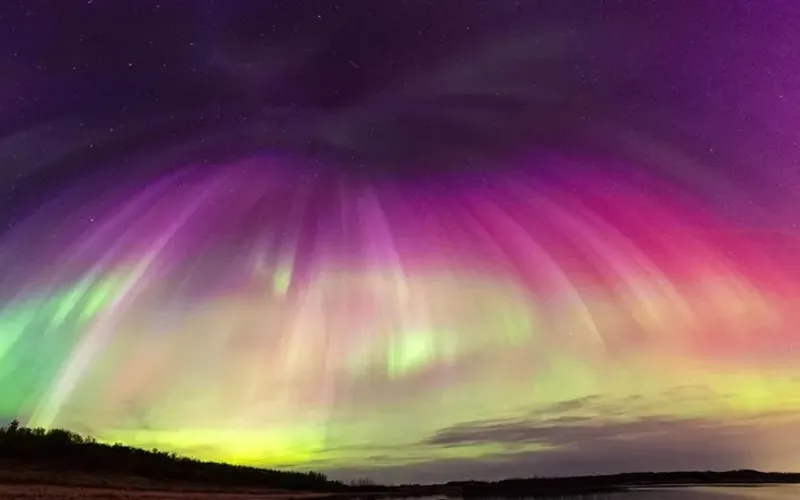
The Northern Lights are created when charged solar particles collide with Earth’s magnetic field, triggering dazzling ribbons of green, purple, and pink light in the atmosphere.
While the phenomenon is typically confined to Arctic regions and northern latitudes, stronger geomagnetic storms can force the auroral oval the zone where auroras are most visible much farther south than normal.
This week’s solar activity is expected to offer a rare opportunity for residents in several parts of the United States, particularly in the Pacific Northwest, including Washington and sections of Idaho, where conditions may become favourable for viewing the lights.
However, experts caution that visibility may remain uncertain due to seasonal conditions in June, when shorter nights and lingering twilight can reduce darkness levels, making weaker auroral activity more difficult to spot.
Scientists have also noted that the exact visibility line may continue shifting as solar activity evolves, urging observers to stay updated with real-time forecasts and weather conditions before heading out.
For the best chance of witnessing the phenomenon, skywatchers are advised to seek dark, open locations away from city lights, ideally with an unobstructed view toward the northern sky.
Experts also recommend using a smartphone’s Night Mode or long-exposure camera settings, as auroral colours often appear more vividly through camera lenses than to the naked eye.
Although weather patterns and light pollution may influence visibility, astronomers believe the upcoming geomagnetic storm could deliver one of the strongest opportunities to observe the Northern Lights in the United States during 2026, making it a potentially memorable event for astronomy enthusiasts and casual observers alike.