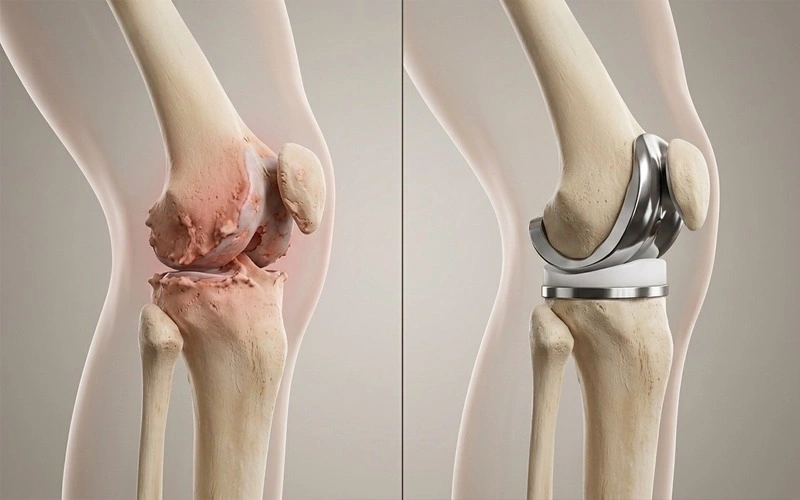
CHICAGO: Joint replacements can restore mobility and relieve chronic pain, but new research is prompting scientists to take a closer look at what happens to implant material years after surgery.
A team of U.S. and Australian researchers found evidence that microscopic metal particles from artificial joints can reach the brain and are associated with changes in proteins linked to Alzheimer’s disease, though the study found no evidence of an effect on cognition.
The findings, based on an analysis of 701 autopsied brain samples from older adults in the United States, do not show that joint replacements cause Alzheimer’s disease or increase the risk of dementia.
Instead, they suggest that material released through years of implant wear can travel beyond the joint and reach neurological tissue, raising questions about its potential long-term effects.
“For years, we’ve known that particles can deposit in tissues surrounding the joint, but this is the first study to look at the particles deposited in the brain,” said Robin Pourzal, director of Implant Materials Analysis in the Department of Orthopedic Surgery at Rush University.
More than 1.5 million people in the United States undergo total joint replacement each year, while more than 7 million Americans are living with Alzheimer’s disease. Both conditions are more common among older adults, making age an obvious explanation for their overlap. Researchers, however, have continued to examine whether other biological factors could also contribute.
One possibility is the microscopic debris produced as artificial joints wear down.
Joint implants can release tiny particles over years of use as their surfaces rub against each other. Previous research has shown that this debris can trigger immune responses around an implant and can enter the bloodstream and reach other parts of the body.
The new study examined whether those particles could also cross the blood-brain barrier.
Researchers analyzed autopsied brain tissue from participants in the Rush Memory and Aging Project. Of 885 participants, 701 brain samples were included in the final analysis of metal concentrations.
The group included 229 people who had undergone total shoulder, knee or hip replacement and 472 people without joint replacements, who served as controls.
The implants studied contained alloys including cobalt-chromium-molybdenum and titanium-aluminum-vanadium. Spectrometric testing showed an association between total hip replacements and higher cobalt concentrations in four regions of the brain.
Brain tissue from people with hip replacements had cobalt concentrations 8.9% higher than tissue from people without implants. Electron microscopy also detected cobalt particles in the brain samples, providing direct evidence that implant-related material can reach neurological tissue.
Researchers then examined amyloid-beta, a protein associated with Alzheimer’s disease. Higher cobalt concentrations were linked to a small increase in amyloid-beta in the inferior temporal cortex. Titanium, meanwhile, showed an inverse association with amyloid-beta levels.
But the study found no association between cobalt or titanium levels and cognitive performance.
That distinction is important. The findings do not establish that metal particles from joint replacements cause Alzheimer’s disease, dementia or cognitive decline. They also do not show that people with joint implants are more likely to develop the disease.
Instead, the research identifies a previously documented pathway for implant debris and suggests that some of the material may reach the brain. Whether that exposure has any meaningful effect on neurological health remains unknown.
The researchers say the issue may warrant particular attention in certain hip replacements that experience accelerated wear, which can generate greater amounts of implant debris.
“Total joint arthroplasty remains one of the most successful and life-changing interventions in modern medicine,” Pourzal said. “But it does suggest that wear particles from the implant, particularly in certain hip replacements involving accelerated wear, may travel beyond the joint and warrant further study.”
The findings do not change the established role of joint replacement as a highly effective treatment for severe joint damage and osteoarthritis. For millions of patients, the procedures can significantly reduce pain and restore mobility.
The next step for researchers is to determine what happens after these particles reach the brain. Whether they remain there, how they interact with surrounding tissue and whether long-term exposure has any measurable neurological consequences.
For now, the study offers a mixed but largely reassuring message: Implant-related metals can reach the brain, but researchers found no evidence in this analysis that they were associated with impaired cognition.