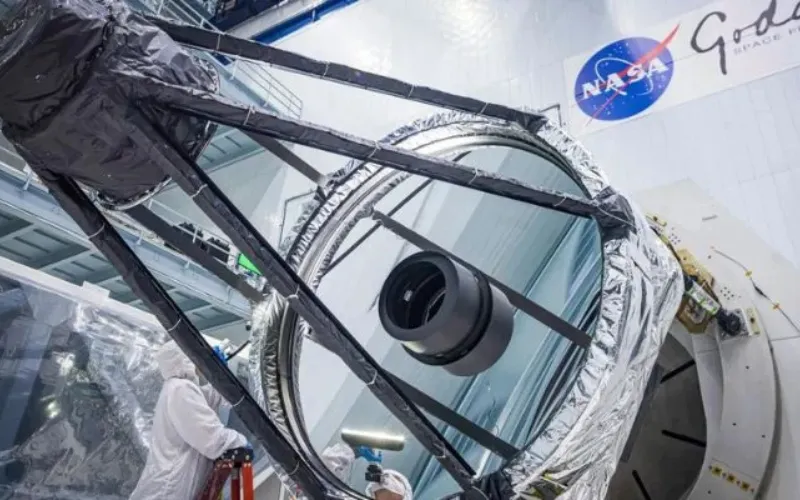
NASA’s Nancy Grace Roman Space Telescope has entered an important stage of its journey to space, as engineers have started attaching the observatory to the equipment that will carry it into orbit.
In an update released this week, NASA said teams at Kennedy Space Center had begun integrating the telescope with SpaceX’s launch hardware ahead of a planned launch later this month.
Roman is now nine months ahead of its original schedule, a rare achievement for a major space mission. Technicians recently connected the observatory to its payload adapter and a special strut attachment fitting designed to handle large and heavy loads. The telescope was then lifted onto the structure that will secure it to the upper stage of SpaceX’s Falcon Heavy rocket.
The Roman telescope will next be placed inside the rocket’s protective payload fairing. The fairing will protect the observatory from aerodynamic forces and heat during its journey into space. After that, the spacecraft will be moved to SpaceX’s integration facility at Launch Complex 39A.
NASA and SpaceX are aiming to launch the Roman Space Telescope as early as August 30. The targeted launch time is 7:26 a.m. EDT from Launch Complex 39A.
Roman arrived at Kennedy Space Center on June 21 after completing major testing at NASA’s Goddard Space Flight Center.
About 1,100 liters of hydrazine propellant were loaded into the observatory on July 25 before its planned journey to the Sun-Earth Lagrange Point 2, located about 1.5 million kilometers from Earth.
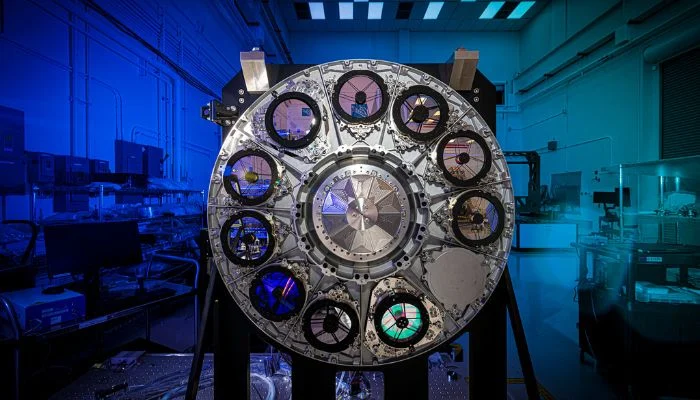
Roman and Hubble have the same 2.4-meter primary mirror. However, Roman uses a Wide Field Instrument that can observe a much larger area of the sky, up to 100 times more than Hubble. Its camera has about 300 megapixels and is designed to study the universe using infrared light.
This will allow scientists to study dark energy, the force believed to be driving the universe’s accelerated expansion, as well as dark matter and thousands of other exoplanets.
Roman’s main mission is expected to last five years, with the possibility of an extension after it reaches its orbit around the Sun-Earth L2 point.