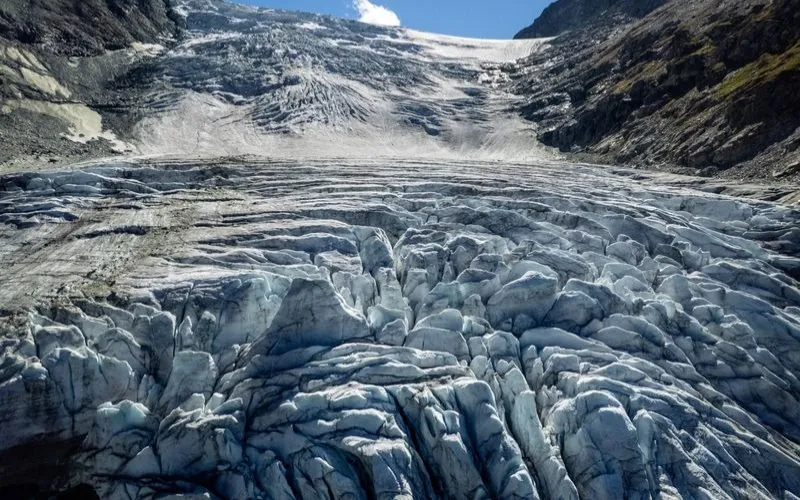
GENEVA: Swiss glaciers are melting at a dangerously accelerated pace as an intense European heatwave pushes Alpine ice loss into one of its earliest and most alarming phases on record, scientists have warned.
Experts from Glacier Monitoring in Switzerland (GLAMOS) say the winter’s accumulated snow and ice is expected to completely disappear by Monday, marking what could become the second-earliest “glacier loss day” ever recorded in the country.
The development signals a critical moment for the Swiss Alps, where any further melting between now and October is expected to sharply reduce glacier mass and intensify long-term environmental damage.
Historically, this tipping point is reached around mid-August. However, this year it has arrived nearly three months earlier than normal, underscoring the severity of the ongoing heat conditions. Only 2022 recorded an earlier occurrence, when the milestone was reached on June 26.
GLAMOS network chief Matthias Huss described the situation as a clear sign of “extreme ablation” across the Alpine region, with both snow and ice disappearing at unusually fast rates.
Read More: Thousands of glaciers to disappear each year by mid-century, study warns
“We are about three months too early compared to a healthy state,” Huss told AFP, adding that multiple Swiss weather stations have already recorded record-breaking temperatures this season.
He cautioned that while individual heatwaves are not the sole cause of glacier decline, prolonged periods of extreme heat are proving devastating.
“The issue is not just one heatwave, but the long duration of high temperatures. Whether it is 35°C or 40°C, sustained heat is extremely harmful for glaciers,” he explained.
Scientists say the crisis has been worsened by a combination of factors, including poor snowfall during winter and the presence of Saharan dust earlier in the year, which darkens ice surfaces and accelerates melting by increasing heat absorption.
This year’s snowfall was also around 25 percent below the 2010–2020 average, leaving glaciers more exposed to summer sun and speeding up the melt process.
Once the bright winter snow layer disappears, darker ice beneath absorbs more solar radiation, creating a dangerous feedback loop that further intensifies melting.
Researchers note that 2026 is already showing patterns similar to 2022 the most extreme glacier melt year ever recorded in the Alps.
The full extent of damage will only be measured in September, but scientists already expect significant ice loss across the Swiss Alps.
Long-term data paints an even more worrying picture: Swiss glaciers have been retreating for around 170 years, with the pace of loss rapidly increasing in recent decades due to rising global temperatures.
Between 2000 and 2024 alone, Switzerland has lost around 38 percent of its glacier volume. In the past 50 years, approximately 1,200 glaciers have disappeared, leaving just around 1,300 remaining.
Experts warn that if current warming trends continue, Swiss glaciers could be reduced to only small remnants by the end of this century reshaping Europe’s water systems and mountain landscapes forever.