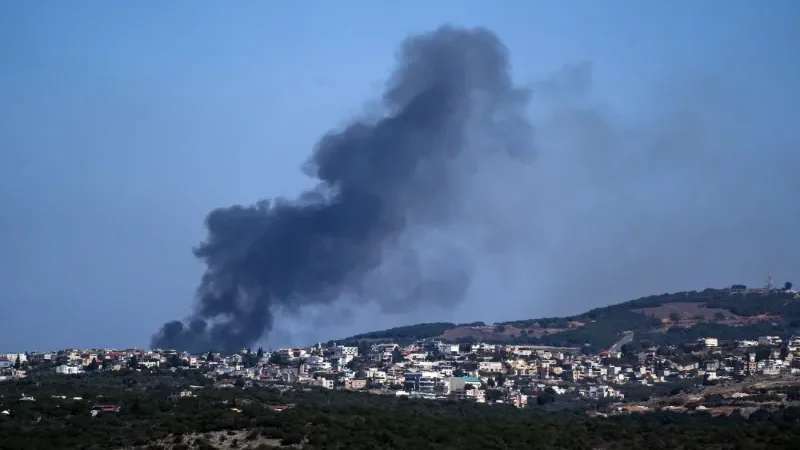
Tensions in the Middle East increased again after a series of military actions, political statements, and missile attacks raised concerns about regional security.
Iranian Foreign Minister Abbas Araqchi rejected comments made by Lebanese President Joseph Aoun, who claimed that Lebanon was being used as a tool by Tehran during its talks with the United States.
The US military reported that Iranian drones were detected heading toward the Strait of Hormuz, a vital water way for global energy shipments. American forces said they destroyed the drones before they could threaten maritime traffic.
In response to those actions, US forces carried out strikes on Iranian coastal radar facilities located in Goruk and on Qeshm Island. The military stated that the operation was intended to prevent additional threats to shipping routes and regional security.
Iran’s Revolutionary Guards later confirmed that they had targeted what they described as enemy military positions in the Gulf region. Iranian state media reported that the attacks were carried out after American forces struck locations inside Iranian territory.
— U.S. Central Command (@CENTCOM) June 6, 2026
Aoun argued that ordinary Lebanese citizens were suffering because of Iran’s political goals. In response, Araqchi dismissed the accusation and said that if Lebanon had truly been a negotiating tool for Iran, an agreement would have been reached long ago. He also urged Lebanon’s leadership to focus on what he described as the country's actual threat.
At the same time, the United States approved a major arms package worth nearly $2 billion for Kuwait. The deal includes advanced anti drone systems supplied by defense company Anduril. Washington said the sale would strengthen the security of a key regional partner and help maintain stability across the Gulf.
American officials described Kuwait as an important ally that plays a significant role in regional economic growth and political balance. Saudi Arabia also reacted strongly to recent developments in Lebanon.
The kingdom condemned an Israeli strike that hit members of the United Nations Interim Force in Lebanon, known as UNIFIL. The attack reportedly killed one peacekeeper and injured several others.
Moments ago, CENTCOM forces shot down four Iranian one-way attack drones that were launched toward the Strait of Hormuz. The attack drones posed an immediate threat to regional maritime traffic. U.S. forces subsequently struck Iranian coastal surveillance radar sites in Goruk and…
— U.S. Central Command (@CENTCOM) June 5, 2026
Riyadh called for accountability and stressed that humanitarian workers, aid personnel, and peacekeeping forces must be protected during conflicts. Saudi officials expressed sympathy to the family of the deceased soldier and wished the wounded a quick recovery.
Military tensions raised further when the US military announced that Iran had launched seven ballistic missiles toward Kuwait and Bahrain. According to American officials, six missiles were intercepted while another failed to reach its intended destination.
Tehran presented the missile launches as a direct response to those operations and maintained that it was defending its national interests.
US President Donald Trump also commented on Iran’s military capability. He claimed that Iran still possessed roughly 21 to 22 percent of its original missile stockpile. Trump acknowledged that Tehran continued to have access to missiles and drones despite previous statements suggesting that Iran’s military strength had been severely weakened. His latest estimate indicated that the country still retained a significant ability to conduct military operations.
Meanwhile, Kuwait announced that its air defense systems were actively responding to missile and drone threats. The country’s armed forces described the attacks as hostile and warned residents that loud explosions heard across certain areas were linked to interception efforts.
Military authorities did not immediately identify the source of the incoming projectiles, but they emphasized that defense units remained fully operational and prepared to protect national territory.
Moments ago, CENTCOM forces shot down four Iranian one-way attack drones that were launched toward the Strait of Hormuz. The attack drones posed an immediate threat to regional maritime traffic. U.S. forces subsequently struck Iranian coastal surveillance radar sites in Goruk and…
— U.S. Central Command (@CENTCOM) June 5, 2026
The latest exchange of attacks has raised fresh doubts about the stability of the ceasefire that had previously reduced hostilities in the region.
With missile launches, air defense operations, retaliatory strikes, and diplomatic disputes taking place within a short period, fears are growing that the situation could develop into a broader confrontation.
Regional governments and international observers continue to monitor events closely as concerns increase over the potential impact on security, trade routes, and diplomatic relations across the Middle East.