KARACHI: The Federation of Pakistan Chambers of Commerce and Industry (FPCCI) has called on Asia-Pacific countries to adopt a joint strategy to strengthen the region's textile industry, improve competitiveness and increase its share in global markets.
These views were presented by Atif Ikram Sheikh, President FPCCI, while he was presenting Pakistan's perspective on regional textile integration at a CACCI webinar titled "Textile Industry in Asia Pacific Region: Opportunities, Challenges and Way Forward." The session was organized under the Asia Textile and Garment Council, which is chaired by FPCCI, and co-organized by the Federation of Bangladesh Chambers of Commerce and Industry.
The webinar was attended by the CACCI Director General and representatives of 28 member chambers. Sheikh thanked the Bangladeshi federation for co-hosting the event and praised CACCI as an important regional platform for business cooperation and economic development.
A growing market
Outlining the global picture, Sheikh said the world textile market is projected to grow from US$2.12 trillion in 2025 to US$4.27 trillion by 2035. Asia-Pacific, which holds about 53 percent of the global market, is expected to expand from US$1.14 trillion to US$2.33 trillion over the same period.
He noted that the textile sector employs around 100 million people worldwide, a figure that rises to roughly 430 million when the wider fashion and apparel industry is included, and contributes about 2 percent to global GDP. China alone accounts for around 32 percent of global textile exports.
Pakistan's strengths
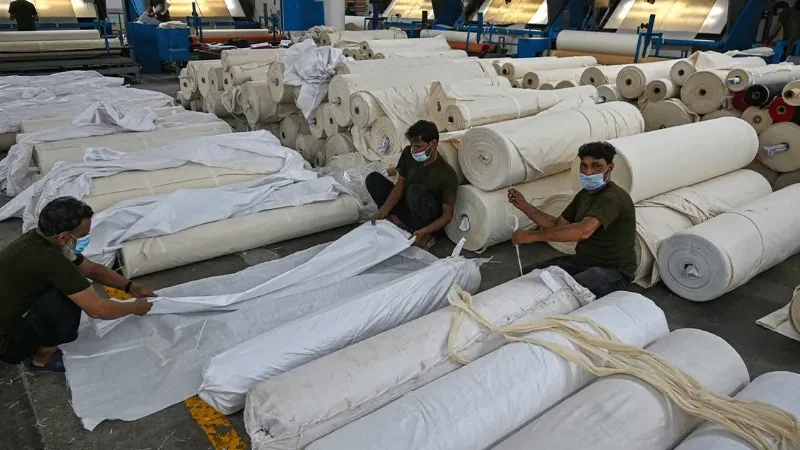
Turning to Pakistan, Sheikh described textiles as the backbone of the national economy, accounting for about 60 percent of exports, which stand at US$17.88 billion. The sector contributes 24.2 percent of industrial value addition and 40 percent of industrial employment.
Pakistan ranks as the 8th-largest textile exporter in Asia, the 3rd-largest yarn producer, the 5th-largest cotton producer and the 4th-largest cotton consumer, he said.
He pointed to the country's integrated value chain, running from cotton cultivation to finished garments, and listed a range of incentives available to the industry. These include duty-free import of machinery, lower tariffs on raw materials, GSP+ access to the European Union, zero-duty access to China, Duty Drawback and concessional financing under the Long-Term Financing Facility (LTFF).
Sheikh also highlighted Pakistan's location as a potential gateway to Central Asia, the Gulf and the Far East. He said this is supported by CPEC connectivity and expanding road and rail corridors linking Pakistan with Türkiye and Central Asia via Iran.
The way forward
Sheikh proposed that Asia-Pacific nations balance competition with closer regional cooperation and explore a joint strategy to expand textile exports to the EU, Africa and the United States. He said future competitiveness will rely increasingly on sustainability, technological innovation, digital traceability, AI-enabled product development, cross-border investment and international branding.
He also identified significant untapped export potential in apparel, home textiles, ready-made garments and industrial textiles, and called for stronger regional value chains and business-to-business partnerships.
Following the presentation, Sheikh took questions from representatives of CACCI national member chambers on supply-chain transparency, regulatory compliance, GSP+ and regional value-chain development.
He concluded by thanking the CACCI leadership and Secretariat for organizing the webinar and providing an effective platform for dialogue on the future of the Asia-Pacific textile industry.