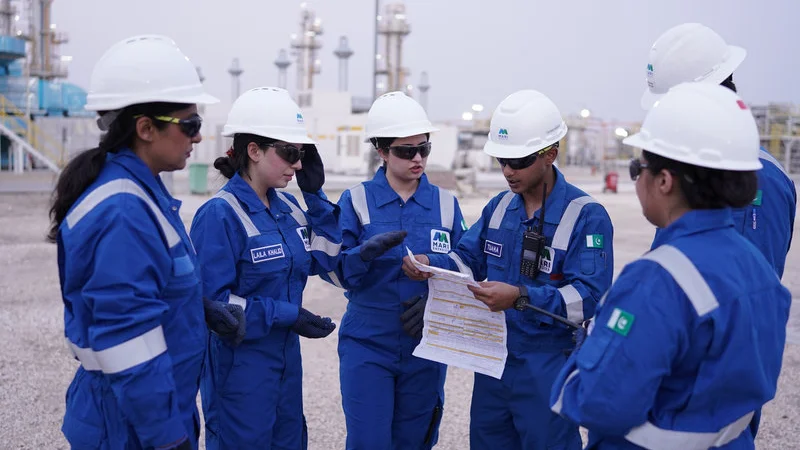
KARACHI: Mari Energies Ltd. said Friday the federal government has approved a 36-year renewal of its Mari Development and Production Lease, extending it to 2065 from the previous expiry of 2029, as the company outlined its FY26 results and future plans at a corporate briefing.
The extension gives the company, listed on the Pakistan Stock Exchange as MARI, long-term certainty over its flagship asset as it expands exploration and development activity onshore and offshore.
Management said the company's combined 2P+2C reserves have grown to 1,029 million barrels of oil equivalent (mmboe) from 642 mmboe over the last five years. The 2P reserve replacement ratio stands at 375%, and the reserves-to-production ratio is 21 years.
The company's finding cost fell to $1.3 per barrel of oil equivalent in FY26 from $12.8 in FY20. Management said it aims to bring the figure down to $1.0 per boe over the next one to two years, in line with the international benchmark. It also said security spending of around 30 cents per barrel is slightly pushing up operating expenses.
During FY26, Mari Energies drilled eight exploration and appraisal wells and made two new discoveries.
One of them, Shams-1, went from spud-in on Jan. 30, 2026, to first production in June 2026. The well was drilled to 3,075 meters and tested at about 48 million cubic feet per day (mmcfd) of gas and 64 barrels of oil per day. Management said its gas has a higher heating value than any previously produced in the Mari D&PL.
In the Waziristan Block, the Spinwam-1 and Shewa wells were commissioned and integrated in April 2026, with production potential of about 40 mmcfd of gas and 250 barrels of oil per day. A full field development plan is ongoing, and the company expects it to add further production.
Management said the Ghazij field is now in full development and secures gas supply for the fertilizer sector for the next decade. Its full potential, however, depends on an increase in fertilizer production capacity.
On the exploration front, drilling is in progress at Ghauri East-1 and Rahi X-1, while seismic acquisition is underway at Karak, Kohat, Harnai and Ziarat.
Offshore, a seismic survey is expected to begin in November 2026, with the first well in Indus Block-C targeted for early FY27-28. Management said offshore seismic acquisition costs are lower than onshore, at around $15,000 to $20,000 per line kilometer. Shallow drilling is also expected to cost $10 million to $20 million per well, compared with more than $40 million for frontier onshore wells.
At the Mari Field, the SML-3 and PKL-9 wells are being drilled. Facilities at the Sujawal and Shah Bandar fields are under way, with potential of about 20 mmcfd and 30 mmcfd, respectively. Pateji-2 is in the planning phase.
Separately, the company has signed a joint venture with Ghani for a greenhouse gas emission project. Financing has been secured from HBL, and commissioning is targeted for July 2027.
The company booked a tax reversal of 18.3 billion rupees in the fourth quarter of FY26, resulting in a tax reversal of 3.8 billion rupees for the full year. Management said it expects no further reversals going forward.