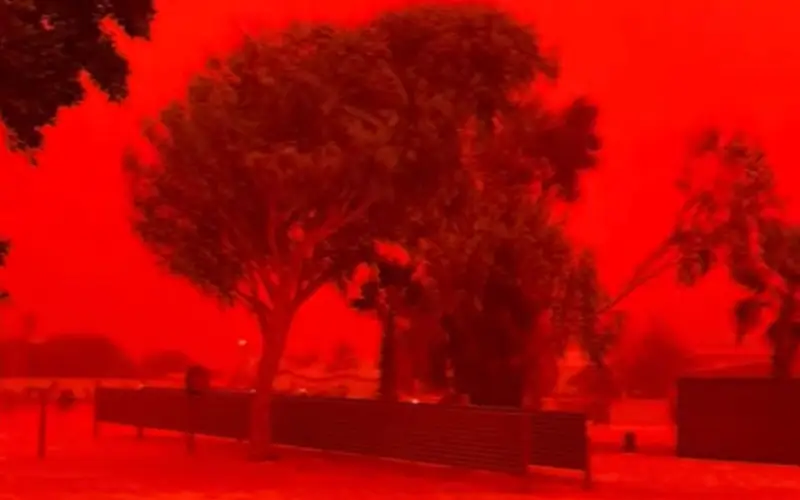
Western Australia is facing dangerous weather conditions as powerful Cyclone Narelle battered several coastal towns and covered them in thick red dust, creating frightening blood-red skies across the region.
The cyclone made landfall in the northwest of Western Australia as a powerful storm before weakening overnight to a category two system. However, it still left a trail of destruction in the Pilbara and North West Cape areas. Strong winds, heavy rain, and flying debris damaged buildings, tore roofs off homes, and caused widespread power outages in several towns.
In the coastal town of Exmouth, which is about 1,250 kilometres north of Perth, residents experienced the full force of the cyclone when wind speeds crossed 250 kilometres per hour. Homes were flooded, and dozens of people had to leave an evacuation centre after it was also damaged by strong winds. The storm later moved south, passing near Coral Bay and Carnarvon, where wind gusts reached more than 100 kilometres per hour.
View this post on Instagram
At the same time, residents reported unusual and dramatic blood-red skies. Entire towns were covered in a thick layer of red dust for hours, making the atmosphere look dark and eerie. Experts say the strange sky colour was caused by powerful cyclone winds that lifted large amounts of desert sand and dust into the air.
Scientists explain that sunlight normally appears blue because shorter wavelengths scatter more easily in the atmosphere. However, when there is a high level of dust, smoke, or pollution in the air, longer red wavelengths become more visible. The strong winds from Cyclone Narelle created the perfect conditions for this effect, which is known as Mie scattering.
Authorities have warned that the cyclone may continue to bring damaging winds and heavy rainfall as it moves further south. Emergency teams are now assessing the damage and working to support affected communities as Western Australia deals with the impact of this powerful storm.