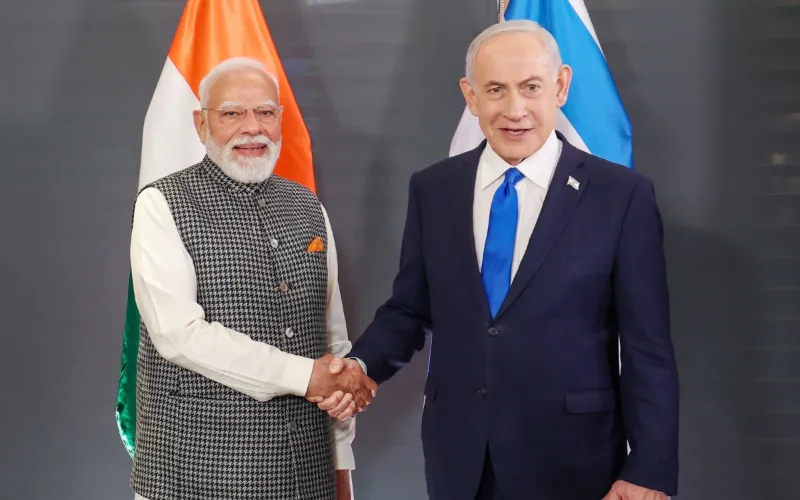
Indian Prime Minister Narendra Modi’s recent visit to Israel has sparked debate in international diplomatic circles, as it took place amid heightened tensions between Israel and Iran.
The UK-based publication Middle East Eye reported that the visit provided political reinforcement to the Israeli government. Meanwhile, Bloomberg characterized the trip as carrying a “risky diplomatic perception.”
Qatar-based broadcaster Al Jazeera highlighted the rapid expansion of defense ties between India and Israel, noting that critics have questioned the implications of deepening strategic cooperation.
Several global media outlets described the timing of the trip as “diplomatically sensitive,” raising questions about whether India is shifting away from its traditionally balanced foreign policy stance.
Opposition Criticism in India
India’s main opposition party, the Indian National Congress, described the visit as a departure from the country’s traditional non-aligned foreign policy. Senior leaders including Sonia Gandhi and Jairam Ramesh argued that overlooking long-standing partners such as Iran could prove strategically costly.
Asaduddin Owaisi, leader of the All India Majlis-e-Ittehadul Muslimeen, questioned whether the government had prior knowledge of potential regional military developments. Left-wing parties and civil society groups also criticized what they described as the personalization of foreign policy decision-making.
Strategic Balance: Israel, the U.S., and Regional Dynamics
During the visit, Modi held talks with Israeli Prime Minister Benjamin Netanyahu, with discussions reportedly focusing on defense and technology cooperation. Analysts view the meeting as significant in the context of India’s expanding security and innovation partnerships in the Middle East.
Statements by retired U.S. Army Colonel Douglas Macgregor also drew attention after he claimed that Indian ports have gained strategic importance during U.S. military activities in the region. However, these remarks have not been officially confirmed.
Economic Stakes: Chabahar and Haifa
India’s involvement in Iran’s Chabahar Port is widely viewed as crucial for accessing Central Asian markets. At the same time, Indian private sector investment in Israel’s Port of Haifa reflects expanding commercial engagement.
Some critics have questioned whether the timing of the visit was aimed at safeguarding economic interests across both regions. The Indian government has rejected suggestions that its foreign policy is driven by specific business considerations.
Impact on Iran Ties?
India and Iran have historically maintained strong relations based on energy cooperation and trade. Critics argue that growing closeness with Israel could complicate New Delhi’s diplomatic balance with Tehran.
However, Indian officials maintain that the country’s “multi-alignment” strategy allows it to sustain relationships with multiple global powers simultaneously, guided by national interest rather than bloc politics.
As regional tensions continue to evolve, Modi’s Israel visit underscores the complexities of India’s foreign policy in a shifting geopolitical landscape.