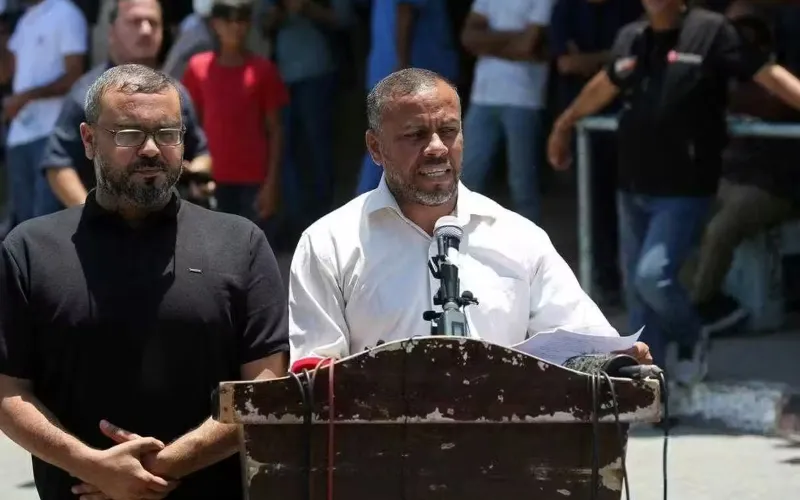
Palestinian Islamist movement Hamas announced Monday the dissolution of the body that has governed the Gaza Strip for nearly two decades, clearing the way for a technocratic committee to implement civilian rule.
The move marks a significant political shift by Hamas, which has run Gaza since its fighters seized control from rival Palestinian movement Fatah in 2007 after winning legislative elections the previous year.
Since a ceasefire between Hamas and Israel took effect in Gaza last October, Hamas has repeatedly said it is willing to step away from governing the territory on a day-to-day basis. However, the issue of the group’s disarmament remains unresolved.
Mohammed Al-Farra, head of Hamas’ Government Emergency Committee, has officially resigned, according to Ismail Al-Thawabta, head of Hamas’ government media office.
He said Al-Farra had also dissolved the committee to facilitate the administrative and governmental transition to the National Committee for the Administration of Gaza (NCAG).
The NCAG, based in Cairo, was established by the Board of Peace created by U.S. President Donald Trump after he brokered the Gaza ceasefire in October 2025.
“Hamas has taken a new step by deciding it will no longer be responsible for governing the Gaza Strip, in order to remove any pretexts for the occupation, which continues its aggression and war of extermination,” Hamas spokesman Hazem Qassem told AFP.
“We hope the National Committee for the Administration of Gaza will enter Gaza soon, and Hamas is ready to hand over governmental responsibilities to ensure the committee’s success.”
A Hamas official earlier told AFP that the group had already informed other Palestinian factions of the decision during a recent meeting in Cairo.
According to the official, the factions welcomed Hamas’ decision and described it as a serious step that would allow the National Committee to take over governing responsibilities.
The dissolution of the 15-member Hamas committee clears the way for the NCAG, headed by Palestinian technocrat Ali Shaath, to assume administrative responsibilities in Gaza.
Ali Shaath said in a post on X that the National Committee is fully prepared to assume its national responsibilities as soon as the necessary resources and capabilities are available.
The committee has remained in Cairo for several months because Israel has reportedly objected to its entry into the war-devastated Gaza Strip, which is home to about 2.1 million people.
Gaza-based political analyst Mkhaimar Abusada described Hamas’ move as a “symbolic gesture.”
He said the main issue is not the dissolution of Hamas’ governing committee but reaching an agreement on disarmament.
“Hamas has not agreed to disarm itself, and that remains the main sticking point,” he said.
Hamas and other Palestinian factions have held several rounds of talks in Cairo with mediators to narrow their differences, particularly over the second phase of the ceasefire, which includes Hamas’ disarmament.
A diplomatic source who attended some of the Cairo talks said Hamas’ latest decision serves several purposes.
“From Hamas’ perspective, this checks a few boxes,” the source said.
“It shows they are moving the process forward and shifts attention to what they describe as Israel’s failure to fulfill its commitments.”
During the first phase of the ceasefire, Hamas released the remaining Israeli hostages in exchange for Palestinians held by Israel.
The second phase, which was expected to include Hamas’ disarmament and a gradual withdrawal of Israeli forces from Gaza, has been delayed for months.
Instead, Israeli forces have expanded their presence in Gaza in recent months and now control nearly 70% of the territory.
Meanwhile, Hamas says it wants a Palestinian administration to be established before it considers handing over any of its weapons.
The future governance of Gaza remains one of the biggest obstacles in negotiations over the second phase of the ceasefire.
Israel opposes any return of Hamas to power and also rejects, for now, a direct takeover by the Ramallah-based Palestinian Authority.
Both Hamas and Israel continue to accuse each other of violating the ceasefire.
According to Gaza’s Health Ministry, which operates under Hamas and whose figures are considered reliable by the United Nations, at least 1,072 Palestinians have been killed since the ceasefire began.
The Israeli military says it has lost five soldiers and one contractor in Gaza during the same period.