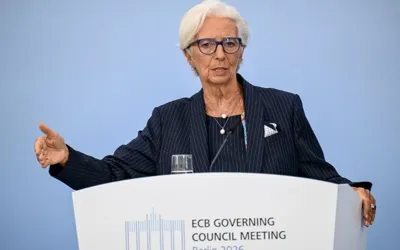
FRANKFURT: European Central Bank President Christine Lagarde announced Thursday that she will step down on Feb. 7, 2027, nearly nine months before her term expires, triggering a succession race amid political uncertainty and mounting fiscal pressure in France.
Lagarde has led the ECB since July 2019, steering the institution through the COVID-19 pandemic, Russia’s war against Ukraine and energy price shocks that pushed inflation in the European Union above 11% in 2022. The surge in prices also brought an end to the era of negative interest rates that followed the global financial crisis.
Her early departure will allow the process of selecting a successor to begin immediately and conclude before France’s presidential election in 2027. The timing is significant because opinion polls have suggested that far-right politician Marine Le Pen is a leading contender in the French election.
Lagarde has repeatedly dismissed speculation that she intends to run for the French presidency. An early exit would also mean that the next French president would have no role in selecting the next ECB chief.
Felix Feather, an economist at Aberdeen Investments, said the timing was particularly significant given the political and fiscal uncertainty surrounding France.
Lagarde did not immediately provide a reason for her decision. Her announcement came after the ECB decided to leave interest rates unchanged at its October meeting.
Spain’s Pablo Hernández de Cos and the Netherlands’ Klaas Knot are widely regarded as leading contenders to succeed Lagarde.
Hernández de Cos served as governor of the Bank of Spain from 2018 to 2024 and is now general manager of the Bank for International Settlements. Knot led the Dutch central bank from 2011 to 2025 and currently serves as a distinguished visiting fellow at the Peterson Institute for International Economics.
The succession process will take place alongside other senior ECB appointments, with Chief Economist Philip Lane and Executive Board member Isabel Schnabel also due to leave their positions in 2027.
Although the ECB operates independently, appointments to its top positions are made by the European Council following consultations with the European Parliament and euro area member states. Negotiations often reflect competing national interests and political considerations.
The choice of the next ECB president is expected to carry particular significance as France faces rising borrowing costs and growing concerns about its public finances.
French government bond yields have risen relative to German benchmark bonds, reviving concerns about financial instability across the euro area.
Holger Schmieding, chief economist at Berenberg, said Knot’s experience as former chair of the G20 Financial Stability Board could give him an advantage in responding to potential market turbulence.
Knot is generally viewed as more hawkish on monetary policy, having previously argued that the ECB risked responding too cautiously to the inflation surge.
His appointment could be interpreted by markets as a signal of a tougher approach to inflation, potentially supporting the euro while increasing pressure on French and other euro area bond markets, according to Pierre Roke of Validus Risk Management.
Hernández de Cos, by contrast, could signal greater continuity and a stronger emphasis on financial stability.
ING Global Head of Macro Carsten Brzeski said national political considerations would also influence the selection, including the positions of northern European governments and Spain’s current administration.
Lagarde received a standing ovation from the ECB’s Governing Council following her announcement.
“It has been a source of great pride to serve this institution,” she said, thanking those who had supported her over the past seven years.
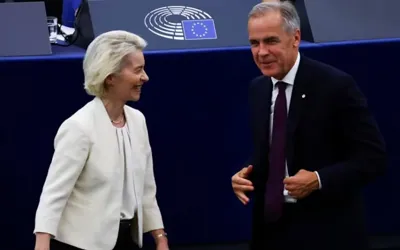
European Council President António Costa praised her leadership, saying she had helped safeguard the stability and resilience of the euro area.
Born in Paris in 1956, Lagarde began her career as a lawyer before entering French politics. In 2007, she became the first woman to serve as finance minister of a Group of Seven country.
She was appointed managing director of the International Monetary Fund in 2011, becoming the first woman to hold that position, before taking over as ECB president in 2019.
Lagarde has also faced criticism during her tenure. A staff survey in 2024 reportedly raised concerns about her leadership style and focus on issues beyond monetary policy.
She is now considered a potential candidate to lead the World Economic Forum, according to media reports.