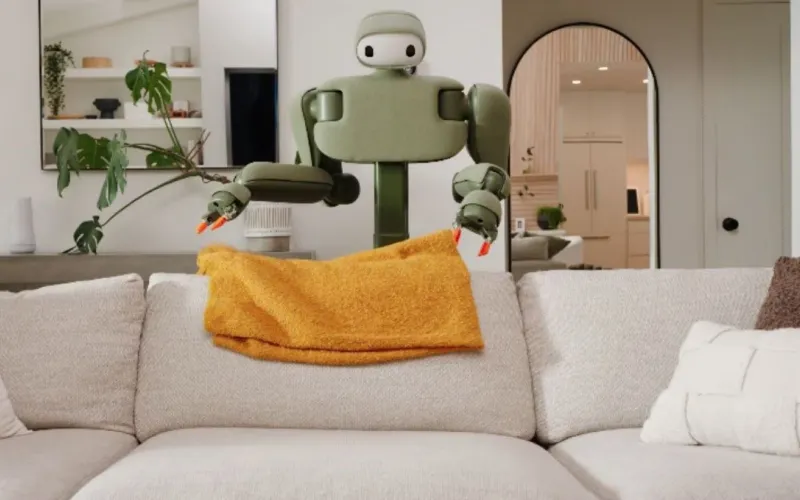
Y Combinator–backed robotics startup Weave Robotics has introduced its new home assistant robot, “Isaac 1,” designed to perform everyday household tasks including folding laundry, making beds, and tidying living spaces.
The company has priced the robot at $7,999 for outright purchase or $449 per month through a subscription model. Isaac 1 is available in five pastel colour options, reflecting the company’s focus on consumer-friendly design.
Following its announcement, Weave’s launch post on X attracted significant attention, generating over 13 million views and approximately 14,000 likes.
Household task automation
According to Weave Robotics, Isaac 1 is capable of independently handling basic domestic chores such as laundry folding, bed-making, and general household cleaning.
The robot is designed to operate autonomously by default, although it can also be remotely controlled by a human operator when it encounters tasks it cannot complete on its own.
Industry observers have described the device as resembling a robotic vacuum equipped with arms. Simon Taylor, head of market development at financial technology firm Tempo, referred to it as a “Roomba with arms,” while some social media users criticized the robot as slow and mechanically limited.
Competitive pricing in a growing market
At nearly $8,000, Isaac 1 is positioned significantly below some competing humanoid robotics systems. Robotics company 1X is currently accepting preorders for its Neo home robot at approximately $20,000, while Tesla has not yet disclosed pricing for its Optimus humanoid robot, which remains in development.
Chris Paxton, an AI innovation lead at Agility Robotics, said the pricing reflects industry progress toward more accessible household automation technologies, suggesting that domestic robots may eventually reduce the burden of routine chores.
Privacy and data concerns
Despite its technological promise, Isaac 1 has raised questions regarding privacy and data usage. Weave Robotics’ privacy policy indicates that user data may be used to improve and enhance its services, although it remains unclear whether in-home recordings will be used to train future models.
The robot is equipped with camera shutters that indicate when its sensors are active. Its charging station also includes a privacy screen, which the company says is intended to improve user transparency and control over data collection.
Technical challenges in home robotics
Experts note that developing reliable household robots remains a significant technical challenge due to the unpredictable nature of domestic environments.
Unlike AI systems trained on large-scale digital data, physical robots must learn to navigate complex and variable real-world settings.
As a result, robots like Isaac 1 may still require human intervention when encountering unfamiliar objects or situations not included in their training data.
Market competition and industry outlook
Isaac 1 enters an increasingly competitive market for home robotics, where no company has yet achieved large-scale consumer deployment of humanoid domestic robots.
Competitors include 1X, which plans to begin deliveries of its Neo robot later this year, and Tesla, which has indicated that production of its Optimus robot could begin in the coming months.
Tesla envisions Optimus being used for household chores, caregiving, and factory work, although consumer availability has not yet been confirmed.
Industry commentary has reflected growing anticipation around the sector, with investor Jason Calacanis describing recent developments as a sign that the robotics industry is “about to get very strange.”
Weave Robotics’ launch of Isaac 1 highlights accelerating competition in the home robotics sector, where companies are racing to commercialize machines capable of performing routine domestic tasks. However, challenges related to reliability, cost, and privacy remain key obstacles to widespread adoption.